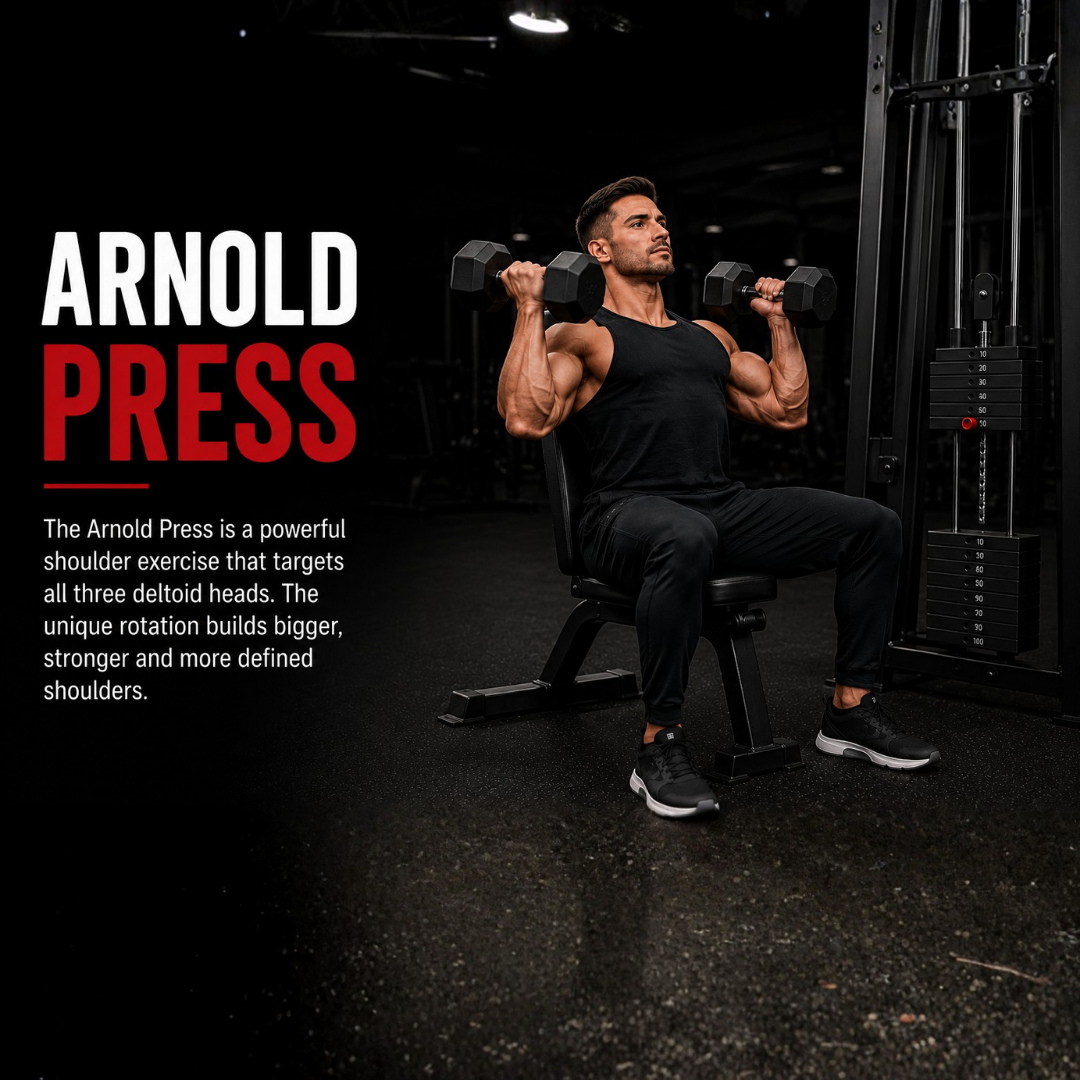
The Arnold Press is one of the most effective shoulder exercises for building stronger, fuller, and more defined deltoids. Unlike a traditional shoulder press, this movement combines pressing with controlled wrist rotation, increasing muscle activation across the front, side, and rear deltoids in a single exercise.
Named after legendary bodybuilder Arnold Schwarzenegger, the Arnold Press was developed to maximise shoulder development through a greater range of motion. Whether your goal is muscle growth, improved strength, better shoulder stability, or athletic performance, this exercise deserves a place in your upper body workout routine.
Master every exercise with expert coaching, personalised training plans, and a supportive gym environment designed to help you achieve real, lasting results.
Starting Position
Sit or stand holding two dumbbells at shoulder height. Your palms should face your chest.
Grip
Hold the dumbbells with a neutral grip. Keep your wrists straight throughout the movement.
Body Position
Brace your core. Keep your chest lifted. Maintain a neutral spine. Avoid arching your lower back.
Begin the Press
Press both dumbbells upward while slowly rotating your palms away from your body.
Rotation
Continue rotating until your palms face forward at the top. The movement should feel smooth and controlled.
Lockout
Extend your arms without forcefully locking your elbows. Keep your shoulders relaxed rather than shrugging.
Lower the Weights
Lower the dumbbells slowly while reversing the rotation until your palms face your body again.
Breathing
Inhale as you lower the weights. Exhale while pressing upward.
Start with light dumbbells.
Practise the wrist rotation before increasing weight.
Move slowly.
Focus on technique before lifting heavier.
| Arnold Press | Dumbbell Shoulder Press |
|---|---|
| Higher difficulty | Easier to learn |
| Greater muscle activation | Less overall activation |
| Larger range of motion | Standard pressing motion |
| More shoulder stability required | Greater overall stability |
| Slightly higher shoulder demand | Lower shoulder stress |
| Best for hypertrophy | Best for strength and beginners |
For the best results:
Keep your core engaged throughout.
Avoid leaning backwards.
Rotate your wrists smoothly.
Control both the lifting and lowering phases.
Keep your elbows slightly in front of your body.
Maintain neutral wrists.
Keep your shoulders down and away from your ears.
Use a full range of motion.
The Arnold Press primarily targets the anterior, lateral, and posterior deltoids. It also recruits the triceps, trapezius, upper chest, rotator cuff muscles, and core during the standing variation, making it an excellent compound shoulder exercise.
Neither exercise is universally better. The Arnold Press offers greater muscle activation and range of motion, while the traditional shoulder press allows heavier lifting and is generally easier for beginners.
Yes, the Arnold Press is safe when performed with proper technique, suitable weights, and controlled movement. Avoid excessive weight and stop if you experience shoulder pain.
Absolutely. Beginners should start with light dumbbells, focus on smooth wrist rotation, and master the technique before progressing to heavier loads.
Seated Arnold Presses improve stability and isolate the shoulders, while standing Arnold Presses engage the core and improve functional strength. Both variations are effective depending on your training goals.
Choose a weight that allows you to complete every repetition with perfect form. If your movement becomes unstable or your lower back arches excessively, reduce the load.
For muscle growth, perform 3–4 sets of 8–12 repetitions. For muscular endurance, use lighter weights for 12–15 repetitions. Strength-focused lifters may use heavier weights for 4–6 repetitions while maintaining excellent technique.

 Blogs
Blogs