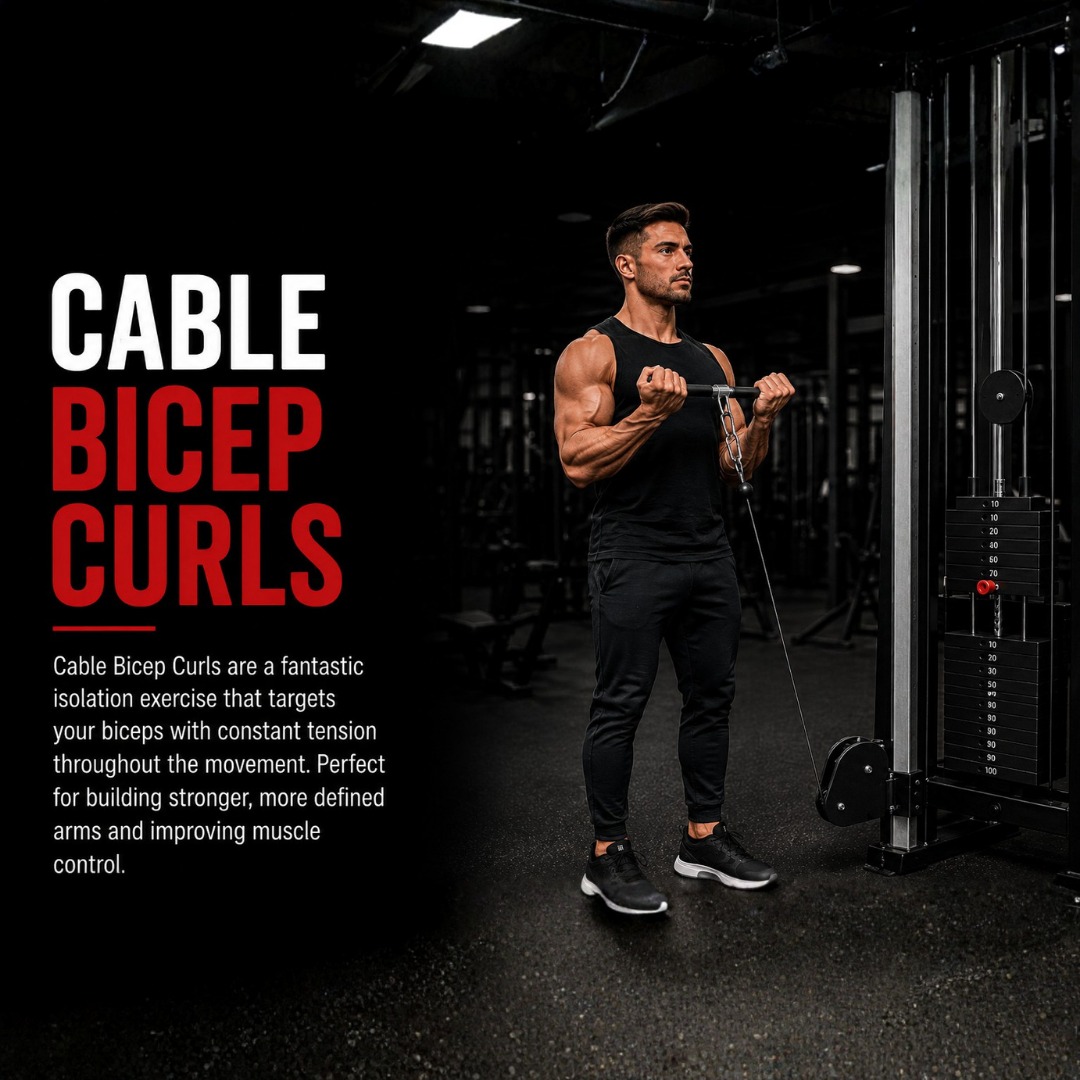
Cable Bicep Curls are one of the most effective isolation exercises for building stronger, bigger, and more defined arms. Unlike free weights, the cable machine provides constant resistance throughout the movement, helping your biceps stay under tension from start to finish. Whether you're a beginner learning correct lifting technique or an experienced gym member aiming for muscle growth, Cable Bicep Curls are an excellent addition to any upper-body workout routine.
If your goal is complete arm development, combine Cable Bicep Curls with Barbell Curls to challenge your muscles from different angles. To build a stronger upper body, include Barbell Bench Press for pushing strength, Barbell Bent Over Row and Close Grip Lat Pulldown for pulling power, and Archer Push Ups to improve upper-body stability and bodyweight strength.
Master every exercise with expert coaching, personalised training plans, and a supportive gym environment designed to help you achieve real, lasting results.
Your elbows should stay tucked into your sides throughout the movement. This keeps the focus on your biceps instead of your shoulders. If your elbows drift forward, the front deltoids begin to take over, reducing the effectiveness of the Cable Curl Exercise.
Don't swing your upper body to lift the weight. Every repetition should come from bending your elbows, not using your back or hips. Using controlled movement helps improve muscle activation and makes Cable Bicep Curls more effective for building stronger arms.
Select a weight that allows you to complete every repetition with good form. Heavy weights often lead to poor technique and reduced muscle engagement. It's better to lift a lighter weight correctly than a heavier weight with poor Cable Curl Form.
Don't let the cable pull your arms back quickly. Lower the weight slowly while maintaining control. The lowering phase increases time under tension, which supports muscle growth and improves overall strength.
Start with your arms fully extended and curl the attachment until your biceps are fully contracted. A complete range of motion helps develop the entire biceps and improves flexibility around the elbow joint.
Maintain straight wrists throughout the movement. Avoid bending them backwards or forwards. Neutral wrists improve comfort, increase grip strength, and reduce unnecessary stress on the wrist joints.
Keep your chest up, shoulders back, and spine in a neutral position. Good posture improves stability and ensures your biceps perform most of the work during each repetition.
Tighten your abdominal muscles before every repetition. A stable core prevents unnecessary body movement. Core engagement also helps maintain balance when performing heavier Cable Machine Bicep Curls.
Pause for one or two seconds at the top of every repetition. This improves your mind-muscle connection and increases muscle fibre recruitment for better arm development.
Slow, controlled repetitions produce better results than lifting quickly. Take around two seconds to lift the weight and three seconds to lower it for maximum muscle tension.
A straight bar is excellent for traditional curls, while an EZ bar can reduce wrist discomfort. A rope attachment allows a greater squeeze at the top of the movement. Changing attachments occasionally also provides a fresh training stimulus for continued progress.
Perform light arm movements and a few warm-up sets before your working sets. A proper warm-up increases blood flow, improves mobility, and prepares your muscles for heavier lifting.
Exhale as you curl the weight towards your shoulders and inhale as you lower it. Proper breathing helps improve stability and allows you to generate more strength throughout the movement.
Completing fewer perfect repetitions is far more effective than performing many poor-quality reps. Prioritising technique helps you achieve consistent muscle growth while reducing the risk of injury.
For complete arm development, combine Cable Bicep Curls with Barbell Curls to challenge the muscles using different resistance patterns.
Follow these steps to perform Cable Bicep Curls with excellent technique and maximise muscle growth.
Set Up the Cable Machine
Attach a straight bar, EZ bar, or rope to the lowest pulley on the cable machine. Select a weight that allows you to complete every repetition with good control rather than relying on momentum.
Choose the Correct Grip
Stand facing the machine and hold the attachment using an underhand grip with your hands approximately shoulder-width apart. Your grip should feel comfortable without placing unnecessary stress on your wrists.
Stand in the Correct Position
Stand with your feet about shoulder-width apart and keep a slight bend in your knees. Maintain a tall posture with your chest lifted and shoulders relaxed throughout the exercise.
Keep Your Elbows Close
Allow your arms to hang naturally while keeping your elbows tucked close to your sides. Your elbows should stay in this position during every repetition to ensure the biceps perform most of the work.
Brace Your Core
Tighten your abdominal muscles before beginning each repetition. A strong core helps prevent your body from leaning backwards and improves stability during the lift.
Curl the Weight Slowly
Exhale as you bend your elbows and bring the attachment towards your shoulders. Focus on squeezing your biceps rather than simply moving the weight from one point to another. Avoid swinging your upper body or lifting your elbows.
Pause at the Top
When the attachment reaches shoulder height, pause briefly and squeeze your biceps as hard as possible. This short pause increases your mind-muscle connection and encourages greater muscle fibre recruitment.
Lower the Weight Under Control
Inhale as you slowly lower the attachment back to the starting position. Resist the weight instead of allowing it to pull your arms down. A controlled lowering phase increases muscle tension and can lead to better strength and muscle development.
Complete All Repetitions
Perform every repetition using the same controlled technique. Stop your set if your form begins to break down rather than sacrificing quality for extra repetitions.
Reset Before Your Next Set
Take time to recover, shake out your arms if needed, and prepare for your next set. Consistent technique across every set delivers better long-term results than lifting heavier weights with poor form.
Pro Tip
Think about pulling your little fingers towards your shoulders rather than simply lifting the bar. This simple cue helps create a stronger biceps contraction and improves your Cable Curl Technique throughout the exercise.
Both exercises are excellent for building stronger biceps. Cable Bicep Curls provide constant tension throughout the movement, while dumbbell curls rely on gravity and have varying resistance. Including both in your training programme helps develop your biceps from different angles and supports balanced muscle growth.
Yes. Cable Bicep Curls are one of the best isolation exercises for increasing biceps size. The constant cable resistance keeps your muscles under tension during the entire repetition, encouraging muscle growth when combined with progressive overload, proper nutrition, and adequate recovery.
A straight bar is the most common attachment because it allows a strong and balanced grip. An EZ bar may feel more comfortable for people with wrist discomfort, while a rope attachment increases the squeeze at the top of the movement. Try different attachments to find the one that suits your training goals.
Absolutely. Cable Bicep Curls are beginner-friendly because the cable machine provides a controlled movement path. Start with a light weight, focus on proper Cable Curl Technique, and increase resistance gradually as your strength improves.
Choose a weight that allows you to complete 8–15 repetitions while maintaining perfect form. If you need to swing your body or move your elbows excessively, the weight is too heavy. Good technique always produces better long-term results than lifting the heaviest load possible.
For muscle growth, aim for 3–4 sets of 8–12 repetitions. Beginners may start with 2–3 sets using lighter resistance, while experienced gym members can increase training volume gradually as their strength improves.

 Blogs
Blogs