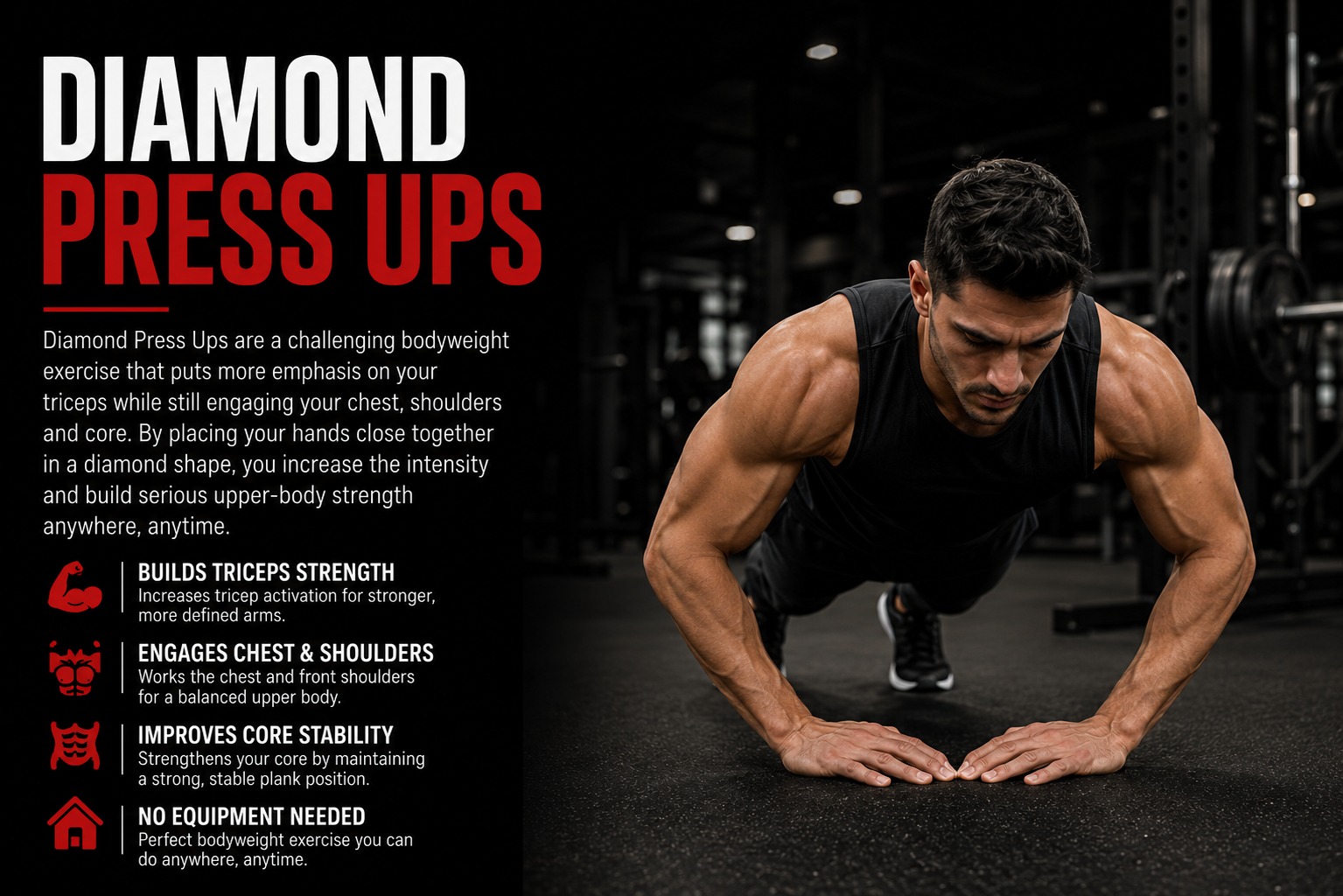
Diamond Press Ups are a challenging bodyweight exercise that can add extra emphasis to the triceps while still training the chest, shoulders and core. Unlike a standard press up, your hands are positioned close together beneath your chest, with your thumbs and fingers forming a diamond or triangle shape.
This narrower hand position changes the way you press your body away from the floor and can make each repetition feel more demanding. Diamond press ups can be useful for building upper-body pressing strength, improving body control and adding variety to a home or gym workout.
In this guide, you will learn what diamond press ups are, which muscles they work, how to perform them with good form, common mistakes to avoid, beginner-friendly alternatives and ways to progress the exercise.
Master every exercise with expert coaching, personalised training plans, and a supportive gym environment designed to help you achieve real, lasting results.
Diamond press ups, also called diamond push ups or triangle push ups, are a close-hand variation of the traditional press up.
To perform the exercise, place your hands close together underneath your chest. Your thumbs and index fingers come towards each other to create a diamond or triangle-like shape. From there, you lower your chest towards the floor while keeping your body controlled, then press back to the starting position.
The closer hand position increases the contribution of the triceps during the pressing movement. Your chest and front shoulders also remain involved, while your core works to keep your body stable.
Because the hands are positioned closer together, diamond press ups can feel considerably harder than regular press ups. The movement also requires good wrist, shoulder and elbow control, so forcing an uncomfortable hand position is not necessary.
The triceps are one of the main muscles involved in diamond press ups. They help extend your elbows as you push your body away from the floor. The close hand position can increase the demand placed on the triceps compared with a wider press-up position, making this a useful bodyweight tricep exercise.
Your pectoral muscles help control the lowering phase and contribute to pressing your body upwards. Diamond press ups should not be considered a chest-isolation exercise, but the chest remains an important part of the movement.
Explore more chest exercises in the Kayi Fitness exercise library .
The anterior deltoids, or front shoulder muscles, assist with the pressing action. They work alongside the chest and triceps to move your upper body through each repetition.
Your abdominal muscles and other muscles around your trunk help maintain a stable plank position. Good core tension prevents your hips from dropping or lifting excessively as you perform the exercise.
Builds Triceps Strength
Diamond press ups provide a convenient way to challenge the triceps without using weights or machines.
Trains the Chest and Shoulders
Although the triceps receive significant attention, the chest and front shoulders also contribute to every controlled repetition.
Improves Upper-Body Pressing Strength
Regular practice can help you become stronger at pressing your bodyweight from the floor.
Develops Core Stability
Holding a strong plank while completing the repetitions requires your core to resist unwanted movement.
Requires No Equipment
You only need enough floor space, making diamond press ups useful for home workouts, travel workouts or equipment-free training.
Adds Variety To Your Training
Changing your hand position gives you another option when building a programme around different press-up variations.
Can Support Bodyweight Progressions
Once you have developed good control, diamond press ups can become part of a wider progression towards more demanding bodyweight exercises.
Start in a high plank position. Place your hands on the floor and extend your legs behind you.
Bring your hands closer together. Position them underneath your chest rather than as wide as you would for a traditional press up.
Create a diamond or triangle shape. Bring your thumbs and index fingers towards each other. Do not force the shape if it causes discomfort.
Set your body position. Keep your head, shoulders, hips and legs controlled in one strong line.
Brace your core. Tighten your abdominal muscles and keep your glutes engaged so your hips remain stable.
Lower your body. Bend your elbows and lower your chest towards the floor in a slow, controlled movement.
Control your elbows. Keep them reasonably close to your body rather than allowing them to flare excessively.
Press the floor away. Push through your hands and extend your elbows to return to the starting position.
Repeat with control. Focus on consistent technique rather than rushing to complete more repetitions.
Keep your body controlled from head to heels.
Brace your core throughout every repetition.
Keep your glutes engaged without excessively squeezing or lifting your hips.
Keep your head in a neutral position.
Lower yourself under control rather than dropping quickly.
Keep your elbows reasonably close to your sides.
Use a hand position that feels stable and comfortable.
Aim for a consistent range of motion.
Stop the set when your technique starts to break down. Quality repetitions are more useful than simply chasing a high number.
For a wider selection of upper-body movements, browse the Kayi Fitness exercise guides .
Hands Positioned Too Far Forward
Placing your hands too far in front of your body can make the movement feel awkward and reduce control. Aim to keep them positioned beneath your chest.
Hips Sagging
Allowing your hips to drop can reduce the quality of your plank position. Keep your core and glutes engaged throughout the repetition.
Excessive Elbow Flare
Letting the elbows move far away from the body can change the mechanics of the exercise. Keep them reasonably close while still allowing a natural movement pattern.
Dropping Too Quickly
A fast descent can make it harder to control the movement. Use a controlled lowering phase and maintain your body position.
Using A Very Short Range Of Motion
Only moving slightly up and down may reduce the challenge of the exercise. Work through a comfortable range that you can control.
Forcing The Diamond Shape
Your hands do not need to form a perfect diamond. If the position causes unnecessary wrist or hand discomfort, adjust the spacing.
Chasing Repetitions
Trying to reach a specific number while your form is deteriorating is rarely useful. Stop or switch to an easier variation when you can no longer maintain good technique.
Diamond press ups can be demanding for someone who is new to bodyweight training. Instead of forcing full repetitions, start with a variation that allows you to learn the movement.
Incline diamond press ups are a useful starting point. Place your hands on a stable raised surface and perform the movement at an easier angle.
You can also use knee diamond press ups. Keep your hands in the close position while supporting your lower body on your knees.
If you are still developing basic pressing strength, regular press ups can provide a useful foundation. Once you can perform them with consistent control, gradually introduce the diamond variation.
Progress to the full version when you can complete the movement without losing your body position or experiencing unnecessary discomfort.
Place your hands on a stable elevated surface. The higher the surface, the easier the movement generally becomes.
Support your knees on the floor while keeping your upper-body position controlled. This reduces the amount of bodyweight you need to press.
The traditional floor version provides the main challenge and requires good upper-body and core control.
Slow down the lowering phase to increase control and make each repetition more demanding without adding external weight.
Using a suitable stable setup can increase the available range of motion. This is a more advanced option and should only be used when you already have strong control.
Raising your feet increases the challenge and changes the loading demands. It should be reserved for people who can already perform standard diamond press ups comfortably.
The main difference is hand position.
Regular press ups normally use a more conventional hand position, while diamond press ups bring the hands closer together. This closer position generally increases the role of the triceps while still involving the chest and shoulders.
Diamond press ups may also feel harder because the close hand position requires more upper-body control. Regular press ups can be easier to learn and are often a better starting point for beginners.
Neither exercise is universally better. Choose based on your training goal, current strength and the rest of your programme.
You can combine press-up variations with other movements from the Kayi Fitness exercise library .
There is no single repetition target that works for everyone.
Start with an easier variation and perform controlled sets where you can maintain good technique. The number of repetitions will depend on your current pressing strength.
Use the standard variation for challenging sets while keeping your technique consistent. You can gradually increase repetitions or sets as your strength improves.
More experienced trainees can increase difficulty through tempo, harder variations or additional training volume.
Your choice should depend on your training goal, recovery, current ability and overall programme. Progressive overload does not always mean simply doing more repetitions.
Perform a manageable number of sets and focus on controlled technique.
You can also use diamond press ups towards the end of an upper-body session when you want an additional bodyweight pressing movement.
For more gym-based upper-body training ideas, visit the Kayi Fitness exercise library .
Yes. Diamond press ups place substantial demand on the triceps during the pressing movement, while the chest and shoulders also contribute.
They can train the chest as part of an upper-body programme. However, they should not be treated as a chest-isolation exercise because the triceps and shoulders are also heavily involved.
They can be. The close hand position changes the movement and can increase the challenge for the triceps and upper body.
Yes, but beginners may benefit from starting with incline or knee diamond press ups before progressing to the full floor variation.
They can contribute to muscle development when performed with appropriate effort, sufficient training volume and progressive overload. Your overall training and nutrition also matter.
Use an incline surface or perform the movement from your knees. You can also practise regular press ups to build foundational pressing strength.
The ideal frequency depends on your overall programme and recovery. Avoid repeatedly training the movement hard without allowing adequate recovery between sessions.
Choose a variation that matches your current strength and control. Prioritise smooth, controlled repetitions and avoid forcing an uncomfortable hand or wrist position. If you experience sharp or unusual pain, stop the exercise and seek appropriate professional advice before continuing.

 Blogs
Blogs