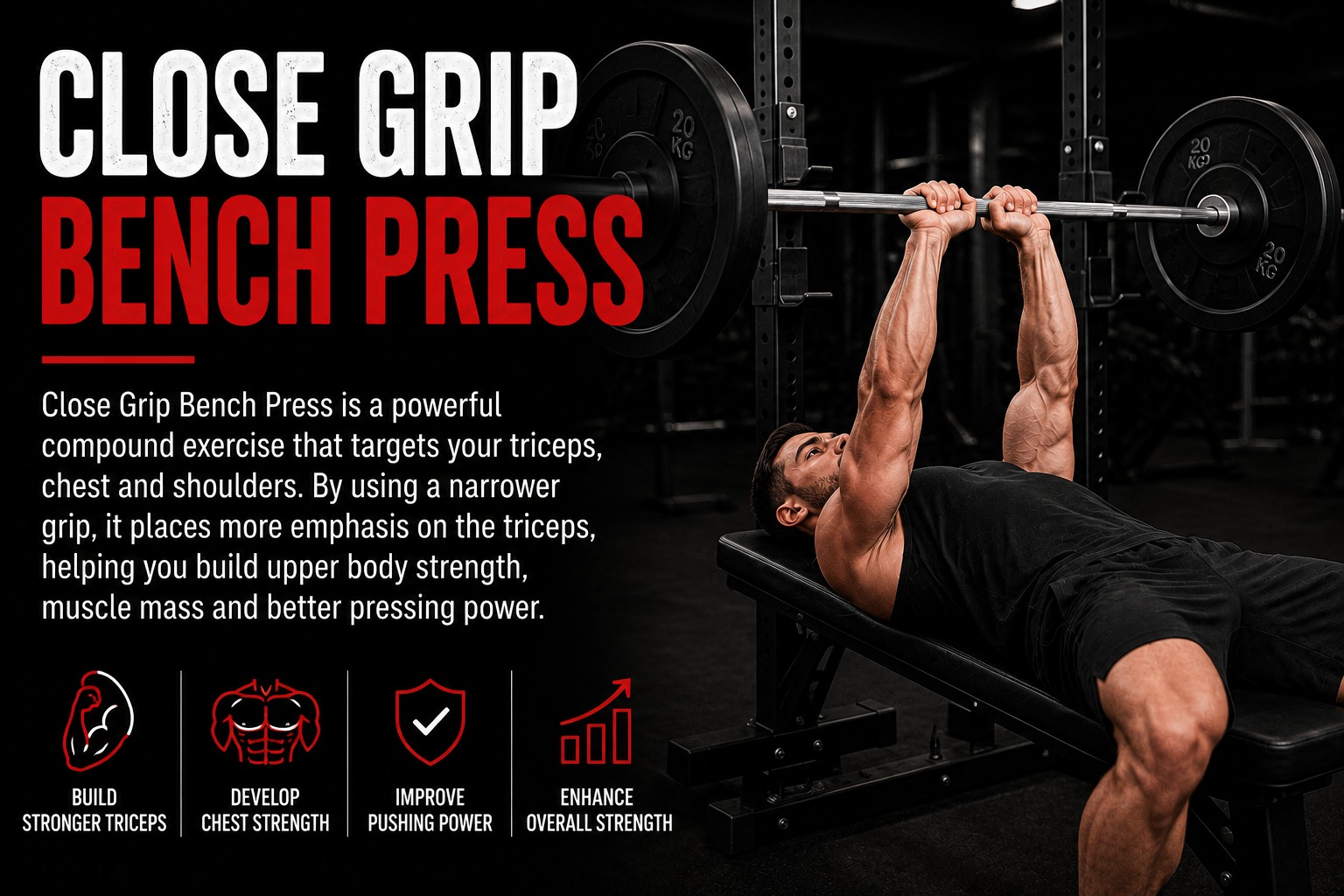
The close grip bench press is a compound upper-body exercise that uses a narrower hand position than a standard bench press. It places strong emphasis on the triceps, while the chest and front shoulders also contribute to the movement.
It is useful for lifters who want to build pressing strength, develop their triceps and add variety to an upper-body training programme. Because the narrower grip changes the movement mechanics, good setup and controlled technique are important. Your hands should be close enough to increase triceps involvement without forcing your wrists or shoulders into an uncomfortable position.
Master every exercise with expert coaching, personalised training plans, and a supportive gym environment designed to help you achieve real, lasting results.
The close grip bench press is a barbell pressing exercise performed on a flat bench. You lower the bar towards your chest while keeping your upper body stable, then press it back to the starting position.
The main difference between this exercise and a standard barbell bench press is hand position. A closer grip generally increases the contribution of the triceps and changes how the chest and shoulders assist with the press.
For beginners, the movement can also be learned with a lighter bar or an unloaded bar before adding weight.
A standard bench press commonly uses a wider grip, while the close grip variation uses a narrower grip. The close grip version is often selected when the lifter wants more emphasis on elbow extension and triceps strength.
The close grip bench press is still a compound exercise, so it does not completely isolate the triceps.
The close grip bench press trains several upper-body muscles at the same time.
The triceps brachii are major contributors to the exercise. They help extend the elbows as you press the bar away from your chest. This makes the close grip bench press a useful compound movement for triceps strength and development.
The pectoralis major, or chest muscles, also contribute to the press. They help produce the horizontal pressing movement, particularly as the bar moves away from the chest. A narrower grip does not remove chest involvement — it simply changes the contribution of the muscles compared with your usual bench press technique.
The front portion of the shoulders, known as the anterior deltoids, assists with pressing the bar. They work alongside the chest and triceps to move the weight.
The exact contribution of each muscle can vary depending on grip width, technique, range of motion, load and individual body proportions.
Follow these steps to perform the exercise with controlled technique.
Set Up the Bench
Place the bench securely inside a suitable rack. Make sure the bar is positioned at a height that allows you to unrack it without excessively reaching or losing your position.
Position Your Body
Lie on the bench with your head, upper back and hips supported. Keep your feet firmly on the floor. Your body should feel stable before you lift the bar.
Choose Your Grip
Place your hands closer together than your normal bench press grip. Avoid taking an extremely narrow grip simply to make the exercise "more" close grip. Your wrists should remain comfortable and reasonably stacked over your forearms.
Set Your Shoulder Blades
Draw your shoulder blades gently back and down to create a stable upper-back position. Do not force an exaggerated position that causes discomfort.
Unrack the Bar
Take a controlled grip and straighten your arms to move the bar away from the rack. Position the bar over your upper chest or shoulder area before beginning the first repetition.
Lower the Bar
Take a breath and slowly bend your elbows as you lower the bar towards your chest. Keep the movement controlled rather than dropping the bar quickly.
Control Your Elbows
Allow your elbows to move naturally while avoiding excessive flaring. The exact elbow position will vary according to your anatomy and grip. The goal is a stable, comfortable pressing position rather than forcing your elbows into an extreme angle.
Reach Your Comfortable Bottom Position
Lower the bar until it reaches your planned range of motion while maintaining control and a stable upper body. For many lifters, the bar will come towards the lower or middle chest area, but the exact position can vary with body proportions and technique.
Press the Bar Up
Drive the bar away from your chest while extending your elbows. Keep your feet planted and your upper back stable.
Finish the Repetition
Return the bar to the starting position without aggressively locking or snapping the elbows. Then repeat for your programmed number of repetitions.
Breathe
A controlled breathing pattern can help you stay braced. Many lifters take a breath before lowering the bar and exhale as they press through the repetition.
Your hands should be close enough to increase triceps involvement without creating unnecessary wrist or shoulder discomfort.
Why it matters: An excessively narrow grip can make the movement uncomfortable and may make it harder to maintain good wrist alignment.
Try to keep the bar positioned securely over your forearms rather than allowing your wrists to bend excessively backwards.
Why it matters: A stable wrist position gives you better control of the bar.
Maintain a stable upper-back position throughout the set.
Why it matters: A firm base helps you control the bar and maintain consistent technique.
Keep both feet securely on the floor.
Why it matters: Stable feet help you maintain a consistent body position during pressing.
Lower and press the bar along a controlled path rather than moving it randomly.
Why it matters: Consistent movement makes it easier to repeat good technique from one repetition to the next.
Use the deepest range you can control comfortably while maintaining good positioning.
Why it matters: Range of motion should support effective training without forcing painful or unstable positions.
Use a controlled lowering phase and a strong but smooth press.
Why it matters: Rushed repetitions can make technique inconsistent and reduce your control of the weight.
Use a resistance that allows you to complete your planned repetitions with good form.
Why it matters: The close grip bench press is not improved by simply adding weight that you cannot control.
1. Hands Positioned Too Close
Mistake: Placing the hands extremely close together.
Why it is a problem: It can make wrist positioning uncomfortable and may create unnecessary strain.
How to fix it: Use a narrower-than-normal grip that still allows comfortable wrist and elbow alignment.
2. Using Excessive Weight
Mistake: Choosing a load that is too heavy to control.
Why it is a problem: Heavy weight can cause poor bar control, shortened range of motion and compensations.
How to fix it: Reduce the load and focus on consistent repetitions.
3. Excessive Elbow Flaring
Mistake: Allowing the elbows to move dramatically outward.
Why it is a problem: It can make the pressing position less stable.
How to fix it: Keep the elbows in a natural, controlled position throughout the movement.
4. Bouncing the Bar
Mistake: Dropping the bar onto the chest and using the rebound to begin the press.
Why it is a problem: It reduces control and can place unnecessary stress on the body.
How to fix it: Lower the bar under control and pause briefly if you need to improve consistency.
5. Losing Shoulder Position
Mistake: Allowing the upper back and shoulders to become loose during the set.
Why it is a problem: Your pressing position can become less stable.
How to fix it: Reset your upper-back position before each set and maintain it throughout the movement.
6. Uncontrolled Lowering
Mistake: Letting the bar fall quickly towards the chest.
Why it is a problem: You lose control of the movement.
How to fix it: Use a deliberate lowering phase.
7. Poor Bar Path
Mistake: Moving the bar excessively towards the stomach or face.
Why it is a problem: An inconsistent path can make the movement less efficient and harder to control.
How to fix it: Practise with a lighter load and develop a repeatable bar path.
8. Lifting the Hips Excessively
Mistake: Raising the hips significantly from the bench to move heavier weight.
Why it is a problem: It changes the exercise setup and can turn a controlled repetition into a compensation.
How to fix it: Keep your hips supported and use a load appropriate for your ability.
9. Poor Wrist Alignment
Mistake: Allowing the wrists to bend excessively.
Why it is a problem: It can make the bar harder to control.
How to fix it: Keep the bar securely positioned over the forearms and maintain a stable grip.
10. Rushing Repetitions
Mistake: Performing repetitions as quickly as possible.
Why it is a problem: Fast repetitions can reduce control and consistency.
How to fix it: Use a steady tempo and focus on each repetition.
| Feature | Close Grip Bench Press | Standard Bench Press |
|---|---|---|
| Grip | Narrower | Usually wider |
| Main emphasis | Greater triceps contribution | Strong chest, triceps and shoulder contribution |
| Triceps | High contribution | High contribution |
| Chest | Significant contribution | Significant contribution |
| Front shoulders | Supporting role | Supporting role |
| Typical loading | Often lighter than a lifter's standard bench | Often allows greater loads |
| Training purpose | Triceps and pressing strength | General pressing strength and chest development |
| Beginner suitability | Suitable when taught correctly | Suitable when taught correctly |
Neither exercise is universally better. The best choice depends on your training goal, experience, technique, comfort and overall programme.
Using dumbbells can provide a different pressing experience and allows each arm to work independently.
Useful for: Lifters who want dumbbell-based pressing or additional variety.
The Smith machine provides a guided bar path and can be useful in some gym programmes.
Useful for: Controlled machine-based pressing and situations where a lifter prefers a fixed bar path.
The floor press limits the lower portion of the movement because your upper arms eventually contact the floor.
Useful for: Focusing on the upper portion of the press and reducing the range of motion.
The close grip bench press can be performed with different resistance levels depending on your goal.
Useful for: Adjusting training intensity while keeping the same basic movement pattern.
Beginners do not need to start with heavy weight.
First, learn the basic setup and movement using a very manageable resistance. Practise maintaining a stable upper back, comfortable grip, controlled lowering phase and consistent pressing path.
A few useful beginner principles are:
Start lighter than you think you need.
Practise the movement before chasing heavier numbers.
Keep your repetitions controlled.
Increase resistance gradually.
Stop a set if your technique breaks down.
Use appropriate safety equipment.
Consider a spotter for challenging barbell sets.
Your first goal should be consistent technique, not lifting the maximum possible weight.
The ideal number of sets and repetitions depends on your programme, experience and goal.
Use relatively heavy resistance with lower repetitions and sufficient rest between sets. Every repetition should remain controlled.
Moderate repetitions with a challenging but manageable load can work well. Focus on consistent range of motion and technique rather than simply increasing the weight.
Use a manageable resistance and moderate repetitions that allow you to maintain good form throughout the set.
There is no single set-and-rep scheme that is perfect for everyone. Your total weekly training volume and recovery should also be considered.
Good technique and sensible loading should come before lifting heavier weight.
Use an appropriate resistance for your experience.
Warm up before demanding working sets.
Check that the bench and rack are secure.
Keep the bar under control.
Maintain a stable body position.
Avoid bouncing the bar off your chest.
Use a spotter when appropriate, particularly for challenging sets.
Do not sacrifice technique to complete another repetition.
Stop if you experience sharp or unusual pain.
If you are unsure about your technique, ask a qualified fitness professional for guidance.
The goal is to train hard while maintaining control and good movement quality.
The close grip bench press primarily trains the triceps while also working the chest and front shoulders. The upper back, core and forearms help stabilise the body and bar.
Yes. The exercise is a compound pressing movement with a strong triceps contribution. It can be useful for developing triceps strength when performed with suitable resistance and good technique.
Yes. The chest remains involved even with a closer grip. However, the exercise generally places more emphasis on the triceps compared with your standard bench press setup.
Your hands should be closer than your normal bench press grip, but not so close that your wrists or shoulders become uncomfortable. Choose a grip that allows stable wrists and controlled elbow movement.
Neither is universally better. The close grip version is particularly useful when you want greater triceps involvement, while the standard bench press is often used as a general upper-body pressing exercise.
Yes. Beginners can learn the exercise with light resistance and appropriate coaching. Technique, control and safe setup should come before heavier loading.

 Blogs
Blogs