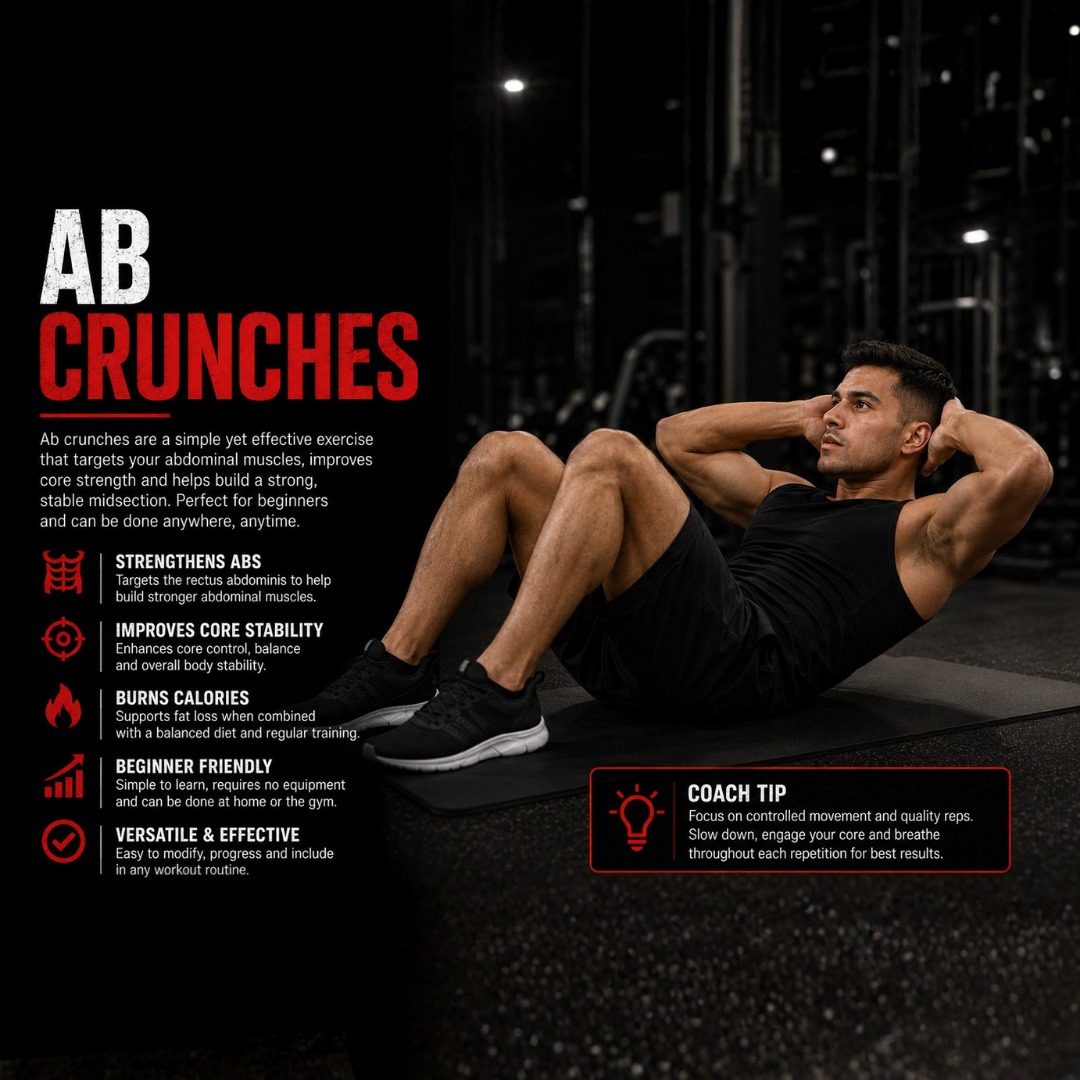
Ab crunches are a simple bodyweight exercise that targets the abdominal muscles. They can be performed at home or in the gym without equipment and are suitable for beginners learning basic core training.
In this guide, you will learn what ab crunches are, which muscles they work, how to perform them with good form, common mistakes to avoid, how they compare to sit-ups, useful variations and ways to progress the exercise.
Master every exercise with expert coaching, personalised training plans, and a supportive gym environment designed to help you achieve real, lasting results.
Ab crunches involve lying on your back, bending your knees and curling your upper torso towards your pelvis. Unlike a full sit-up, a crunch uses a shorter range of motion, with the lower back generally remaining on or close to the floor.
The movement involves controlled spinal flexion. The abdominal muscles contract as you curl your upper torso. Good control is more important than lifting as high or moving as quickly as possible.
The rectus abdominis is the main muscle trained during a standard crunch. It runs along the front of the abdomen and helps produce trunk flexion.
The internal and external obliques can also contribute, particularly during variations involving rotation or side movement.
Other muscles around the trunk help provide stability. For balanced core development, include exercises that train different movement patterns.
Strengthens the Abdominals
Strengthen the abdominal muscles and improve muscular endurance.
Simple For Beginners
Provide a simple option for beginners learning basic core training.
Requires No Equipment
Require no equipment when performed as a bodyweight exercise.
Easy To Progress
Can be progressed through repetitions, tempo, variations or resistance.
Get into position. Lie on your back with your knees bent and feet flat on the floor.
Position your hands. Place your hands lightly behind your head or across your chest. Do not pull on your neck.
Brace your core. Keep your lower body stable throughout the movement.
Curl upwards. Slowly curl your upper torso towards your pelvis.
Control your range. Lift only as far as comfortable; a crunch does not require a full sit-up.
Pause at the top. Hold briefly while maintaining control.
Lower with control. Lower your upper torso slowly to the starting position.
Breathe correctly. Exhale as you curl upwards and inhale as you lower.
Repeat with control. Focus on controlled repetitions rather than completing as many as possible.
Keep your feet stable throughout the movement.
Avoid pulling your head forwards.
Move slowly through the exercise.
Focus on curling your upper torso rather than trying to sit upright.
Avoid momentum during each repetition.
Maintain a comfortable range of motion.
Stop if you experience sharp or unusual pain.
Pulling On The Neck
Use your hands only for light support. Focus on moving from your trunk rather than pulling your head forwards.
Using Momentum
Fast repetitions can reduce control. Slow both the lifting and lowering phases.
Lifting Too High
Trying to sit completely upright changes the exercise. Concentrate on a controlled crunch.
Holding Your Breath
Exhale during the upward phase and inhale as you return.
Crunches use a shorter range of motion, with the lower back generally staying on or close to the floor. Sit-ups involve a larger movement, with more of the torso lifting from the floor. Crunches are often easier for beginners to learn, but neither exercise is automatically better. Your choice should depend on your ability, goals and overall programme.
There is no universal number. Beginners can start with around 2–3 sets of 8–15 controlled repetitions. As your strength improves, gradually increase the challenge through repetitions, resistance or a harder variation. Quality technique should come before a high repetition count.
Bring more focus to the obliques through a rotational movement pattern.
Curl the hips and lower body towards the torso instead of the upper body towards the pelvis.
Combine trunk rotation with alternating leg movement for a more dynamic variation.
Add external resistance to increase the challenge once bodyweight repetitions feel manageable.
Use a cable machine to provide adjustable, consistent resistance through the movement.
A guided option that can help beginners learn the movement pattern with added support.
Each variation changes the movement or training demand, so choose an option that matches your current ability and training goal. You can also combine your core training with exercises for other muscle groups, such as chest exercises, back exercises and leg exercises, to create a more complete programme.
Progress gradually by adding resistance, slowing the lowering phase, pausing at the top, increasing repetitions or moving to a more challenging variation.
Cable crunches and ab crunch machines can provide adjustable resistance. Do not increase difficulty if it causes poor form.
Crunches can strengthen and develop the abdominal muscles, but they cannot guarantee a visible six-pack. Abdominal definition is influenced by muscle development, body-fat levels, genetics, nutrition, physical activity and overall training. Crunches cannot selectively remove fat from the stomach.
Crunches primarily train the abdominal muscles rather than specifically burning belly fat. You cannot choose where your body loses fat by training a particular muscle. Fat loss is influenced by overall energy balance, nutrition, activity and individual factors. Combine core training with a balanced exercise programme and appropriate nutrition.
Yes. Basic crunches require no equipment and have a relatively simple movement pattern. Beginners should start with manageable volume, learn proper technique and gradually increase difficulty.
Use controlled movement, avoid pulling on your head or neck, and do not force an excessive range of motion. Do not train through sharp or unusual pain. Allow recovery between demanding core sessions. If you have an existing injury or medical concern, seek appropriate professional advice before changing your training programme.
Ab crunches primarily train the rectus abdominis, while the obliques and other core muscles can contribute to the movement.
Yes. They are simple, equipment-free and easy to scale according to your current ability.
There is no fixed daily target. Use manageable, high-quality repetitions within your overall training programme.
No. Crunches strengthen the abdominal muscles but do not specifically target belly fat.
Crunches can help develop the abdominal muscles, but visible definition also depends on body composition, genetics, nutrition and overall training.
Crunches use a shorter range of motion, while sit-ups involve lifting more of the torso from the floor.

 Blogs
Blogs