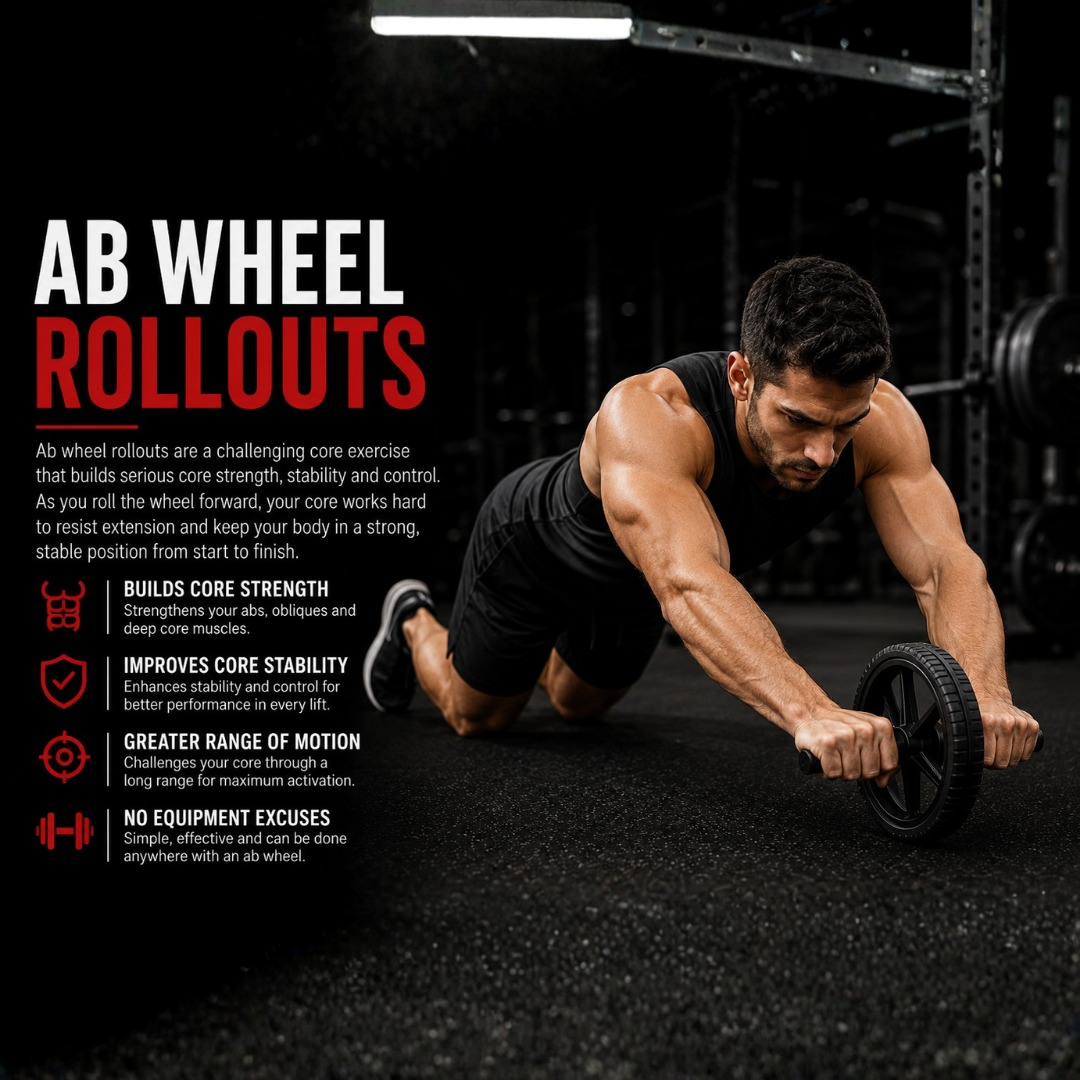
Ab wheel rollouts are a challenging core exercise performed with an ab roller or ab wheel. Starting from a kneeling position, you hold the handles and slowly roll the wheel forward before bringing it back towards your body.
Unlike exercises that mainly involve repeatedly bending the spine, the ab wheel rollout challenges your core to resist excessive spinal extension. This makes it an effective anti-extension exercise for developing core strength, stability and control.
The movement can look simple, but proper technique is important. As the wheel travels forward, the abdominal muscles must work hard to prevent the lower back from arching. Beginners should therefore focus on controlled repetitions and a manageable range of motion rather than trying to roll as far as possible.
Ab wheel rollouts can complement traditional abdominal exercises such as crunches by challenging the core in a different way.
Master every exercise with expert coaching, personalised training plans, and a supportive gym environment designed to help you achieve real, lasting results.
Ab wheel rollouts involve several muscles working together to keep your body stable.
The main abdominal muscle responsible for trunk control during the rollout.
Help stabilise the torso and resist unwanted movement.
Help maintain tension and control around the midsection.
Supports the spine and helps maintain a controlled position.
Help keep the pelvis stable and contribute to whole-body tension.
Control the wheel and support the upper body throughout the movement.
The main challenge is not simply moving the wheel. Your core must remain engaged while resisting the tendency for your hips and lower back to collapse towards the floor.
Adding ab wheel rollouts to your training can provide several practical benefits.
Builds Core Strength
The exercise places significant demand on the muscles responsible for trunk stability.
Improves Core Stability
Your abdominal muscles must maintain control as the wheel moves away from your body.
Develops Abdominal Control
Slow repetitions encourage you to maintain tension throughout the movement.
Improves Body Awareness
You learn to recognise and maintain a strong position under resistance.
Challenges a Large Range of Motion
Progressively increasing your range can make the exercise more demanding.
Supports Strength Training
A stronger, more stable core can help you maintain better positions during other gym exercises.
Ab wheel rollouts should not be viewed as a shortcut to losing belly fat or developing visible abs. Body composition depends on overall nutrition, activity and training. The exercise is best used as part of a balanced strength and fitness programme.
Follow these steps to perform a kneeling ab wheel rollout with proper technique.
Set up on your knees. Place the ab wheel on the floor in front of you and kneel behind it. Hold both handles firmly.
Brace your core. Before moving, tighten your abdominal muscles and squeeze your glutes. Keep your spine in a controlled, neutral position.
Start rolling forward. Slowly push the wheel away from your body while keeping your arms controlled and your core braced.
Maintain your position. As you roll forward, avoid allowing your hips to drop or your lower back to arch excessively.
Use a manageable range. Only travel as far as you can while maintaining good form. You do not need to reach the floor.
Control the return. Pull the wheel back towards your knees using your core and upper body while maintaining tension.
Repeat with control. Perform each repetition slowly rather than using momentum to complete the movement.
The goal is quality movement. If your lower back starts to arch or you lose control, reduce the range of motion.
Arching the Lower Back
Allowing the lower back to overextend is one of the most common technique problems. Correction: brace your core, squeeze your glutes and shorten the rollout distance.
Rolling Too Far
Trying to achieve maximum range before developing sufficient strength can cause your body position to break down. Correction: start with a shorter range and gradually increase it.
Moving Too Quickly
Fast repetitions often rely on momentum rather than controlled core strength. Correction: roll out and return slowly, keeping tension throughout the repetition.
Losing Core Tension
If your abdominal muscles relax, maintaining a strong position becomes difficult. Correction: brace before every repetition and keep your ribs and pelvis controlled.
Letting the Hips Drop
Allowing the hips to sink can place your body in a poor position. Correction: keep your glutes engaged and maintain a stable torso.
Use these coaching cues to improve your ab wheel rollout technique.
Brace your core before every repetition.
Keep the movement slow and controlled.
Squeeze your glutes throughout the rollout.
Keep your ribs controlled rather than allowing the lower back to overarch.
Begin with a shorter range of motion.
Focus on consistent technique rather than chasing a high repetition count.
Increase your range gradually as your strength improves.
If you are new to the ab roller exercise, begin with short-range kneeling rollouts. This allows you to practise bracing and positioning without demanding your maximum range.
As your control improves, gradually increase how far you roll the wheel forward. You can also introduce controlled pauses in the extended position to increase the challenge.
More experienced trainees may progress towards standing ab wheel rollouts. This variation is significantly more demanding because the body starts from a more extended position and requires greater core strength and control. It should only be attempted after you can perform kneeling rollouts confidently with consistent technique.
Yes. Ab wheel rollouts are a demanding core exercise that requires your abdominal and supporting muscles to resist excessive spinal extension while controlling the wheel.
Yes, provided beginners start with a manageable range of motion. Short kneeling rollouts are a good way to learn proper technique before progressing further.
There is no single number that suits everyone. Start with a number of controlled repetitions that you can perform without losing form. Quality should take priority over quantity.
Sharp or persistent pain is not a normal part of the exercise. If you experience pain, stop the movement and reassess your technique. Anyone with an existing injury or medical concern should seek appropriate professional guidance before performing demanding core exercises.
They can strengthen and develop the abdominal muscles, but visible abs depend on overall body composition as well as muscle development. Ab wheel rollouts alone cannot specifically remove belly fat.
Sharp or persistent pain is not a normal part of the exercise. If you experience pain, stop and reassess your technique. Anyone with an existing injury or medical concern should seek appropriate professional guidance before performing demanding core exercises.

 Blogs
Blogs