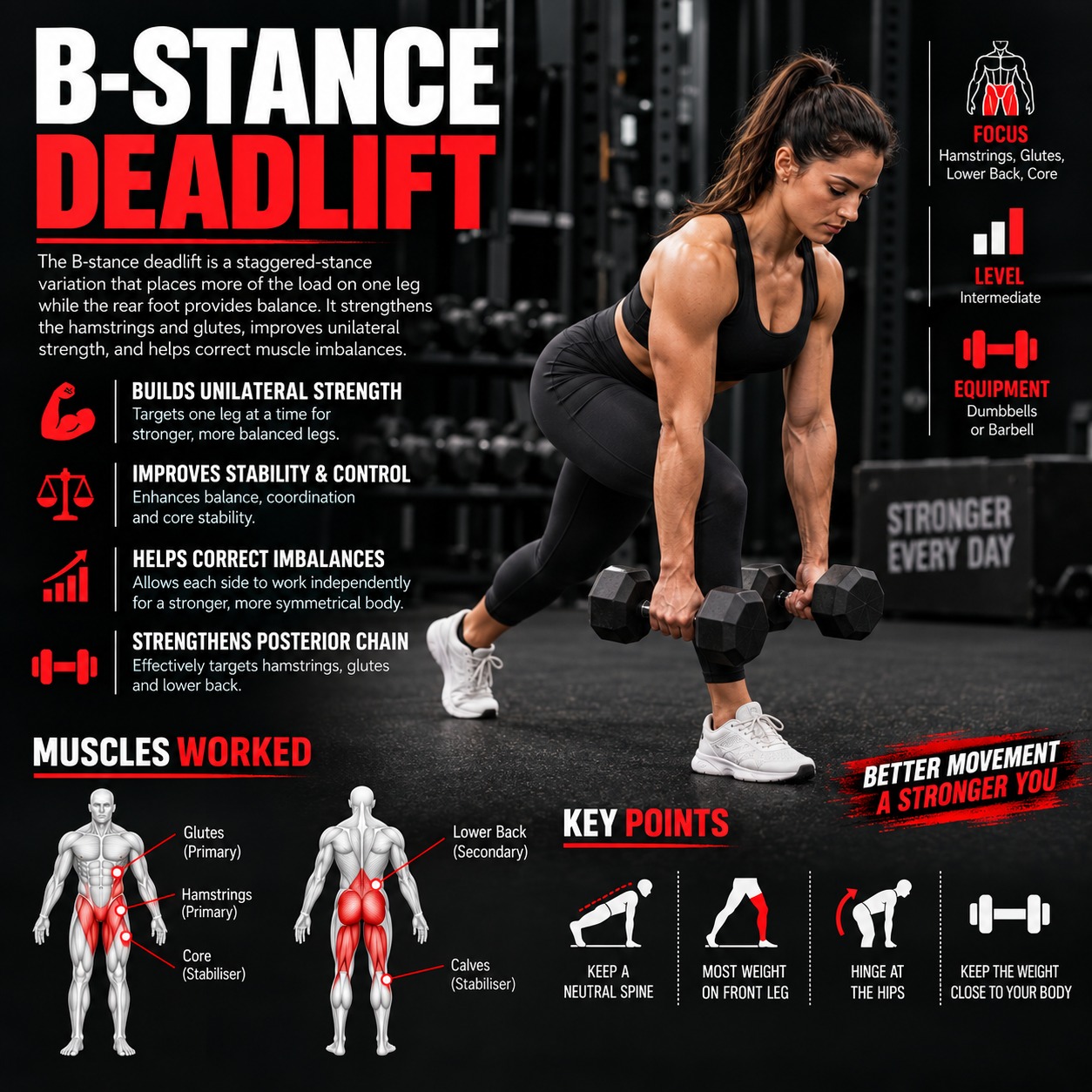
The B-stance deadlift is a unilateral deadlift variation that uses a staggered foot position to place more of the workload on one leg. The rear foot provides balance and support while the front leg performs most of the work.
This exercise follows a similar hip-hinge movement to the Romanian deadlift. However, the staggered stance makes it easier to train one side at a time without requiring the same level of balance as a single-leg deadlift.
The B-stance deadlift is particularly useful for developing the hamstrings, glutes and lower back, while also improving unilateral strength, stability and control.
Master every exercise with expert coaching, personalised training plans, and a supportive gym environment designed to help you achieve real, lasting results.
| Detail | Information |
|---|---|
| Exercise Type | Compound |
| Main Muscles | Hamstrings, glutes |
| Secondary Muscles | Lower back, core |
| Equipment | Barbell or dumbbells |
| Difficulty | Intermediate |
| Movement Pattern | Hip hinge |
| Best For | Lower-body strength and unilateral training |
The B-stance deadlift primarily works the muscles responsible for hip extension.
The hamstrings work hard as you push your hips backwards and lower the weight. They are placed under greater tension as they lengthen during the lowering phase.
Your glutes help extend your hips as you return to the standing position. Keeping most of your weight on the front leg increases the contribution from that side.
The muscles along your spine work to maintain a stable and neutral torso throughout the movement.
Your core muscles help stabilise your pelvis and torso, particularly because the staggered stance creates an additional balance challenge.
Because one leg performs most of the work, the B-stance deadlift can help you train each side independently.
Training each side separately can make differences in strength and control easier to identify and work on.
The rear foot remains in contact with the floor, giving you additional support. This makes the B-stance a useful progression towards more demanding unilateral exercises.
The exercise targets the hamstrings and glutes while also challenging the muscles responsible for maintaining spinal and core stability.
The movement reinforces the hip-hinge pattern used in exercises such as Romanian deadlifts and conventional deadlifts.
Stand with your feet around hip-width apart while holding dumbbells at your sides or positioning a barbell in front of you.
Shift most of your weight onto one leg.
Move the opposite foot slightly backwards and place the toes lightly on the floor.
Keep the front foot firmly planted and maintain most of your body weight through it.
Brace your core and keep your spine neutral.
Push your hips backwards while keeping a slight bend in your front knee.
Lower the weight towards the floor while keeping it close to your body.
Stop when you feel a strong stretch in the hamstrings without losing your position.
Drive your hips forwards and squeeze your glutes to return to standing.
Complete your repetitions before switching sides.
Keep most of your weight on the front leg.
Use the rear foot mainly for balance.
Keep your spine neutral throughout.
Move through your hips rather than squatting down.
Keep the weight close to your body.
Use a controlled lowering phase.
Start with a manageable load before increasing the weight.
Putting too much weight on the rear foot
This reduces the unilateral training effect.
Rounding the back
Keep your core braced and spine neutral throughout each repetition.
Bending the knees too much
Excessive knee flexion can turn the exercise into more of a squat. Focus on pushing the hips backwards.
Using too much weight
Heavy loads can make it difficult to maintain balance and proper technique.
Overextending at the top
Stand tall and squeeze the glutes rather than aggressively pushing the hips forwards.
A B-stance deadlift is a staggered-stance deadlift variation where one leg performs most of the work while the other leg provides support and balance. It is useful for developing unilateral lower-body strength and improving hip-hinge control.
The B-stance deadlift primarily works the hamstrings and glutes. It also engages the erector spinae and core muscles to help maintain stability and control throughout the movement.
The B-stance deadlift and regular deadlift serve different purposes. The B-stance variation places more emphasis on one side of the body, making it useful for unilateral training, while a conventional deadlift allows you to use both legs more evenly.
The B-stance deadlift can be suitable for beginners who have already learned the basic hip-hinge movement. Start with light dumbbells and focus on balance, positioning and controlled movement before increasing the weight.
A B-stance deadlift keeps the supporting foot on the floor, providing greater balance and stability. A single-leg deadlift requires you to balance on one leg, making it a more demanding unilateral exercise.

 Blogs
Blogs