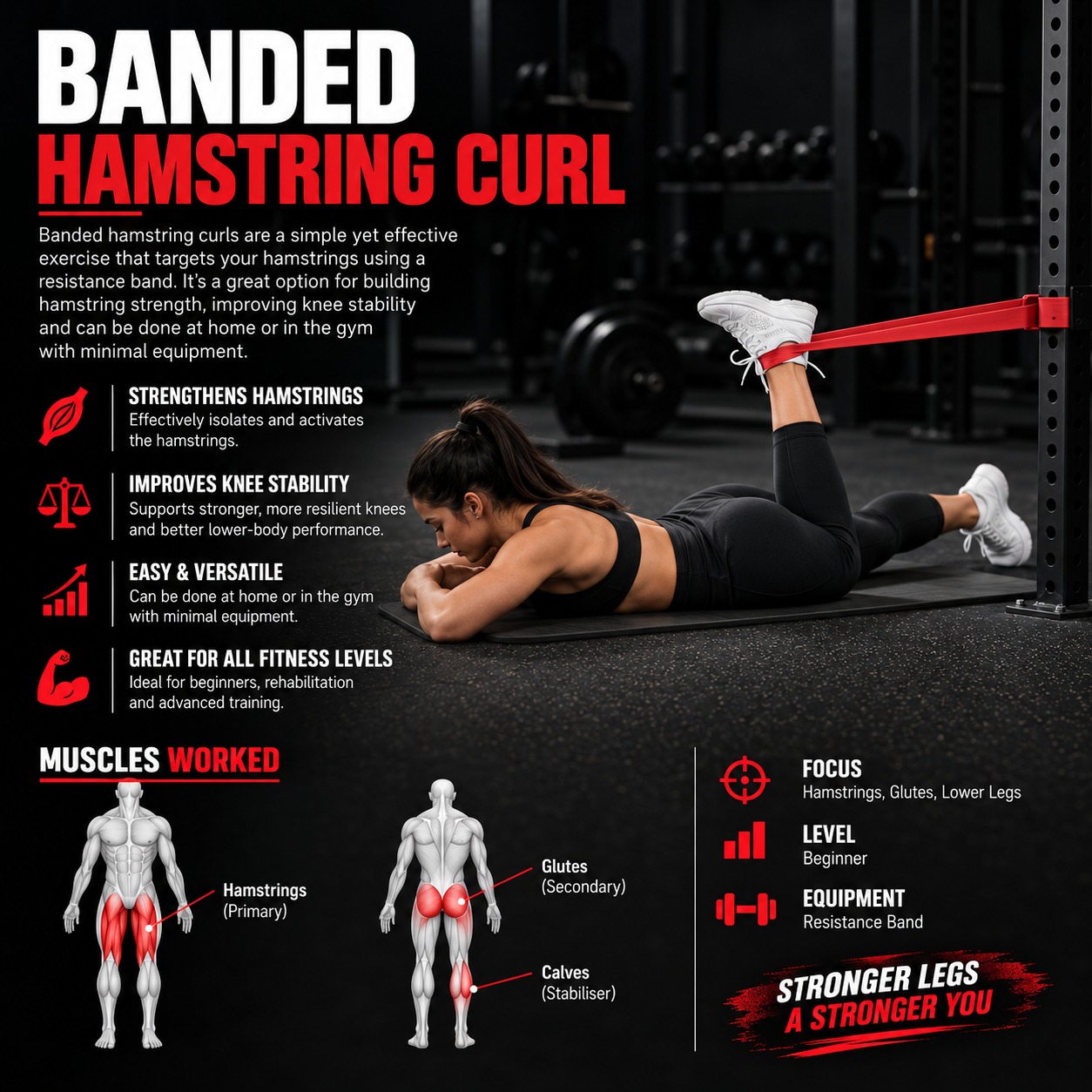
The banded hamstring curl is a simple isolation exercise that targets the hamstrings using a resistance band. Unlike machine leg curls, it requires very little equipment and can be performed at home or in the gym.
The exercise involves bending your knee against resistance while keeping your upper body and hips stable. It is useful for strengthening the hamstrings and can be included in lower-body workouts, warm-ups or hamstring-focused sessions.
Master every exercise with expert coaching, personalised training plans, and a supportive gym environment designed to help you achieve real, lasting results.
| Detail | Information |
|---|---|
| Exercise Type | Isolation |
| Main Muscles | Hamstrings |
| Secondary Muscles | Calves, glutes |
| Equipment | Resistance band |
| Difficulty | Beginner |
| Movement Pattern | Knee flexion |
| Best For | Hamstring strength and activation |
The hamstrings are the main muscles responsible for bending your knee during the curl.
The calf muscles can contribute to knee flexion and help stabilise the lower leg.
Your glutes help maintain a stable hip position, particularly when performing the exercise lying face down.
Strengthen the hamstrings with minimal equipment.
Easy to perform at home or while travelling.
Useful as a warm-up or finisher.
Allow you to train each leg individually.
Help improve control during knee flexion.
Resistance can be adjusted using different bands or changing the band position.
Secure one end of a resistance band to a stable anchor point.
Attach or loop the other end around one ankle.
Lie face down with your legs extended.
Position yourself far enough from the anchor point to create light tension in the band.
Keep your hips pressed towards the floor.
Bend your knee and bring your heel towards your glutes.
Pause briefly when you reach the top of the movement.
Slowly extend your leg back to the starting position.
Repeat for your desired number of repetitions.
Switch legs and repeat.
Keep your hips stable.
Avoid lifting your pelvis from the floor.
Move slowly rather than relying on momentum.
Keep tension in the band throughout the movement.
Focus on squeezing the hamstring at the top.
Use a resistance level that allows controlled repetitions.
Lifting the hips
Keep your pelvis against the floor.
Using momentum
A controlled movement keeps the tension where you want it.
Choosing excessive resistance
Too much resistance can reduce your range of motion and technique.
Moving the whole body
Keep your upper body relaxed and stable.
A banded hamstring curl is an isolation exercise that uses a resistance band to train the hamstrings. It involves bending the knee and bringing the heel towards the glutes against the band's resistance.
Banded hamstring curls primarily target the hamstrings. The glutes and calf muscles can also contribute to the movement and help stabilise the lower leg and hip.
Yes. Banded hamstring curls can effectively strengthen and activate the hamstrings, particularly when performed with controlled movement and an appropriate resistance level. They are also useful when access to gym machines is limited.
Yes. Banded hamstring curls are well suited to home workouts because they require only a resistance band and a secure anchor point. They can also be performed in the gym as part of a lower-body workout.
The number of repetitions depends on your training goal and resistance level. A common starting point is 2–4 sets of 10–20 controlled repetitions per leg. Choose a resistance that allows you to maintain good form throughout the set.

 Blogs
Blogs