The banded leg extension is a simple way to train your quadriceps without relying on a traditional leg-extension machine. With a suitable resistance band, a stable chair and the right setup, you can perform controlled knee extensions at home, in a gym or while travelling.
Unlike squats and lunges, which involve several joints and muscle groups, the banded leg extension is primarily an isolation movement. That makes it useful when you want to add focused quad work to a lower-body session.
The key is not simply extending your leg against the band. Band placement, resistance, stability and controlled tempo all affect how well you can perform the movement.
Master every exercise with expert coaching, personalised training plans, and a supportive gym environment designed to help you achieve real, lasting results.
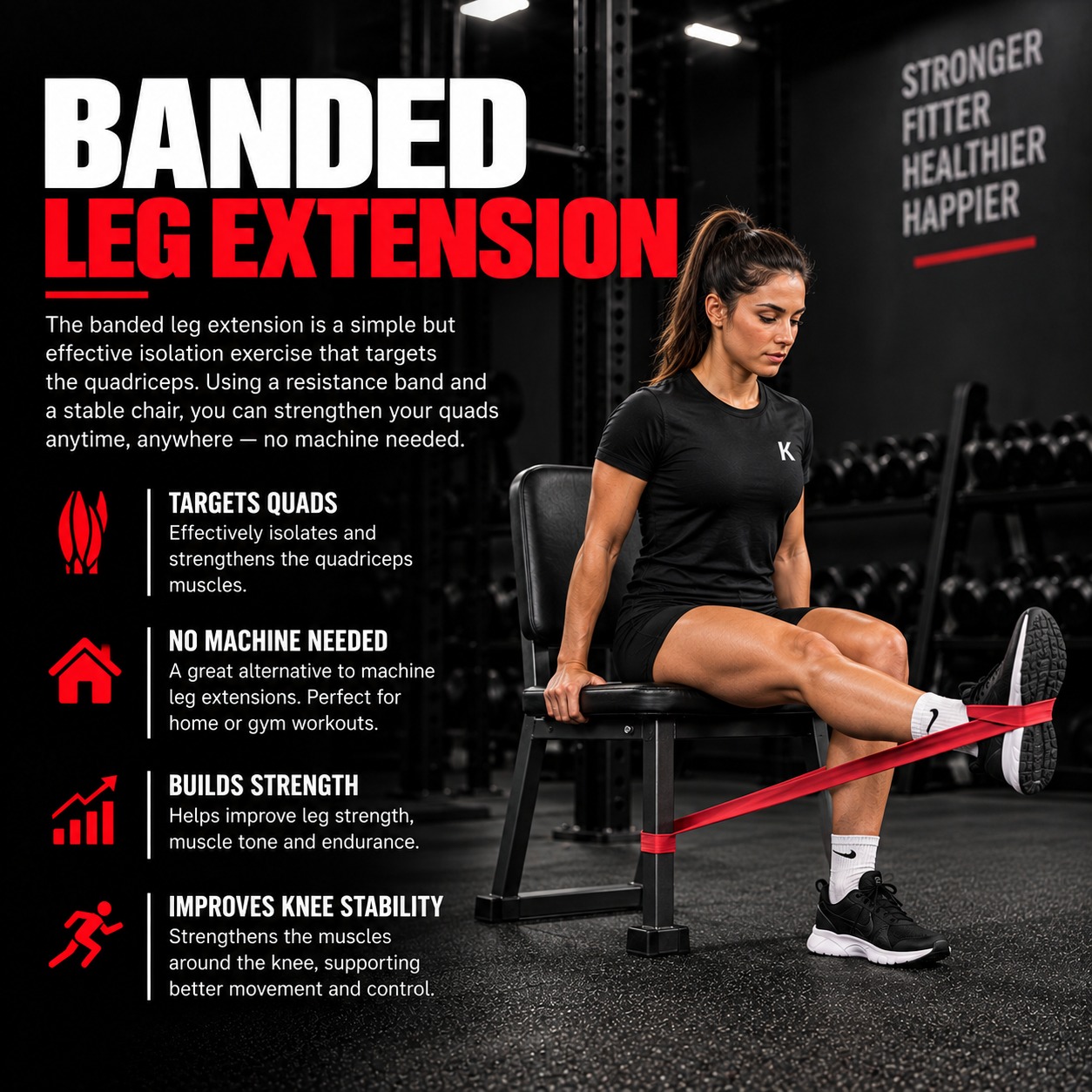
A banded leg extension is a seated knee-extension exercise performed with a resistance band.
You sit on a stable chair and position the band so that it provides resistance as you straighten your knee. As the leg moves from a bent position toward extension, the quadriceps contract to straighten the knee.
The exercise is particularly useful when you:
Train at home with limited equipment
Do not have access to a leg-extension machine
Want an additional quad isolation exercise
Prefer resistance bands for portable training
Want to include unilateral leg work in your programme
The resistance profile is different from a machine. With a band, resistance depends heavily on how much the band is stretched and how it is positioned. That means your setup can make a noticeable difference to the difficulty of the exercise.
Kayi Fitness currently maintains an exercise library covering movements across major muscle groups, making individual exercise guides part of its wider training resource.
The quadriceps are the main muscles trained by the banded leg extension. The quadriceps sit on the front of your thigh and are responsible for extending the knee. During the exercise, they contract to straighten your lower leg against the resistance supplied by the band.
Because the movement is centred around knee extension, you can focus on the quadriceps without requiring the same level of whole-body involvement as a squat or lunge.
Other muscles may contribute to maintaining your position and controlling the movement, particularly the muscles responsible for stabilising your torso and hips.
However, the banded leg extension should primarily be considered a quadriceps-focused exercise, rather than a full lower-body movement.
The setup is especially important with a resistance band. Take a few seconds to check that everything is secure before starting your repetitions.
Place a sturdy chair on a stable, non-slip surface.
Sit upright with your back supported or naturally braced.
Position your feet so your knees are comfortably bent.
Secure the resistance band around a suitable low anchor point or according to the specific band setup you are using.
Position the other part of the band around the lower leg or foot in a way that allows the band to provide resistance during knee extension.
Check that the band is secure and is not likely to slip or snap toward you.
Start with a resistance level that allows you to control the entire movement.
The exact band arrangement can vary depending on the type and length of resistance band available. The goal is to create a stable line of resistance while allowing the working knee to move freely.
Brace your torso and keep your hips stable.
Begin with your working knee comfortably bent.
Extend your leg by straightening the knee against the band's resistance.
Continue until you reach a comfortable controlled end position.
Briefly contract the quadriceps at the top.
Slowly bend the knee and return to the starting position.
Repeat for your desired number of repetitions.
Avoid trying to make the movement harder by swinging your leg. If you cannot control the return phase, the resistance or band setup may be too demanding.
Breathe out as you extend the leg and breathe in as you return it to the starting position.
There is no need to overcomplicate your breathing. The main priority is maintaining control and avoiding breath-holding throughout the set.
Resistance bands are convenient, but they need to be used carefully.
Before every session:
Inspect the band for cracks, tears or signs of damage.
Do not use a damaged or deteriorating band.
Check that the band is securely positioned.
Make sure any anchor point is stable.
Avoid setups where the band could snap directly toward your face or body.
Choose a resistance you can control.
Keep the movement smooth rather than jerky.
Stop the exercise if it produces sharp or unusual pain.
If you have an existing knee issue, have recently had surgery or experience persistent pain during exercise, speak with an appropriately qualified healthcare or exercise professional before adding this movement to your programme.
Good technique makes the exercise easier to control and helps you get more from the resistance available.
Keep your torso stable
Avoid repeatedly rocking backward and forward to complete repetitions. A stable torso keeps the movement focused around the working knee.
Avoid swinging the leg
Momentum can make a difficult resistance feel easier without improving your ability to control the exercise. Extend and lower the leg deliberately.
Use a controlled range of motion
Move through a comfortable range rather than forcing the knee into an aggressive end position.
Pause at the top
A short pause as the knee reaches its controlled end position gives you an opportunity to deliberately contract the quadriceps rather than simply bouncing through the repetition.
Control the lowering phase
Do not allow the band to pull your leg rapidly back to the starting position. A controlled return keeps you actively working throughout the repetition.
Choose the right resistance
If you need to lean, swing or shorten the movement dramatically, the band may be too strong or positioned too aggressively.
Check the band between sets
Resistance bands can shift during exercise. Make sure the band remains correctly positioned before continuing.
Keep the movement about the knee
Your thigh and torso should remain relatively stable while the lower leg performs the extension. Excessive movement elsewhere can turn the exercise into something quite different.
Using too much resistance
A stronger band is not automatically better. Excessive resistance can make it difficult to control the exercise and may encourage compensation through the hips and torso.
Better approach: use enough resistance to challenge the quadriceps while maintaining consistent technique.
Using momentum
Swinging the lower leg can help you move through a repetition without properly controlling the resistance.
Better approach: use a smooth extension followed by a deliberate lowering phase.
Poor band positioning
If the band is loose, unstable or poorly aligned, the resistance can feel unpredictable.
Better approach: test the setup with a few slow repetitions before starting your working set.
Moving your whole body
If your hips slide or your torso repeatedly rocks backward, you may be using body movement to compensate for excessive resistance.
Better approach: stabilise your body and reduce the resistance if necessary.
Rushing the lowering phase
Allowing the band to quickly pull the leg back wastes part of the movement.
Better approach: control the return and maintain tension where your setup allows it.
Forcing the knee
Aggressively snapping into the end position is unnecessary.
Better approach: reach a controlled end position and avoid deliberately forcing the knee beyond a comfortable range.
The movement allows you to concentrate on knee extension and therefore place the main training emphasis on the quadriceps.
One of the biggest advantages is accessibility. A resistance band can provide an alternative when you do not have access to a conventional machine. That makes the exercise particularly practical for home-based lower-body sessions.
A resistance band takes up very little space compared with a machine. It can therefore be useful for travelling, home training or minimalist workout setups.
The banded leg extension can complement compound movements such as squats, lunges and split squats rather than replacing them.
Performing the movement one leg at a time allows you to concentrate on each side independently. This can also make it easier to notice differences in control between legs.
Resistance can be changed by using a different band, altering the setup or increasing the amount of stretch where appropriate. The most useful progression is the one that increases the training challenge without sacrificing control.
Once you can perform your current setup comfortably and consistently, there are several ways to progress.
A higher-resistance band can increase the challenge, provided you can still complete the movement with good control.
Adding repetitions can increase training volume without immediately requiring a much stronger band.
If your current number of sets is manageable, adding another set can provide additional training volume.
Take more time to return the leg to the starting position. This can make a relatively light resistance feel considerably more demanding.
Hold the top position briefly while maintaining control instead of immediately reversing the movement.
Depending on your setup, slightly increasing the starting tension can increase resistance. Do this gradually rather than creating excessive tension.
Training one leg at a time can make the exercise more challenging and gives you greater control over the workload applied to each side.
If you are new to resistance-band training, start with a setup that allows you to learn the movement rather than immediately chasing high resistance. You can make the exercise easier by:
Using a lighter resistance band
Reducing unnecessary starting tension
Performing fewer repetitions
Practising the movement slowly
Using a stable chair
Learning the knee-extension motion without resistance first
Working within a comfortable range of motion
As your control improves, gradually increase the challenge.
There is no single set-and-rep prescription that works for everyone. Your training experience, goal, resistance level and overall workout volume all matter.
2–4 sets of around 8–15 controlled repetitions can be a practical starting range when the resistance allows you to maintain good technique.
Higher repetitions can be used with a manageable resistance, particularly when the goal is to accumulate more repetitions without excessive fatigue.
Start with a resistance that lets you learn the setup and movement confidently. You can increase repetitions, resistance or sets gradually as your technique improves.
The number of repetitions is less useful if the final few repetitions cause your form to break down.
Because the banded leg extension is an isolation movement, it can work particularly well after larger lower-body exercises.
You could perform it after movements such as:
This lets you complete your more demanding compound work before finishing with focused quadriceps training.
A banded leg extension can be paired with other resistance-band exercises for a practical home lower-body session. For example:
As a single-leg movement: Use single-leg extensions when you specifically want to train each side independently.
Kayi Fitness' own training content also places movements such as squats, leg press and lunges within a lower-body training context.
The exercise can be useful for:
Beginners learning basic resistance training
Home exercisers with limited equipment
Intermediate lifters wanting additional quad volume
People who do not have access to a leg-extension machine
Gym-goers looking for another way to isolate the quadriceps
Beginners should prioritise a secure setup and manageable resistance rather than trying to replicate the resistance used on a gym machine.
For anyone with existing knee problems, recent surgery or persistent pain, professional guidance is appropriate before starting the exercise.
Perform the exercise one leg at a time.
Why use it: It allows you to concentrate on each leg independently and can be useful for unilateral training.
Both legs work together.
Why use it: This can be convenient when you want to perform the movement efficiently and use a bilateral setup.
Use a deliberately slower lowering phase.
Why use it: Slowing the movement increases the demand for control without necessarily requiring a heavier band.
Pause briefly near the top of each controlled repetition.
Why use it: The pause prevents you from rushing through the strongest part of the movement and encourages deliberate quadriceps contraction.
Banded leg extensions primarily work the quadriceps, the muscles at the front of the thigh responsible for extending the knee. Other muscles may help stabilise the hips and torso, but the quadriceps are the main target.
Yes, banded leg extensions can be a useful way to train the quadriceps when the resistance and setup allow you to perform controlled repetitions. They are particularly convenient when a traditional leg-extension machine is unavailable.
Yes. A resistance band can be used to create resistance for a seated leg-extension variation. The exact setup depends on the type and length of band, so stability and secure positioning should be checked before beginning.
They can be. Beginners should start with a manageable band resistance and focus on learning a stable setup, controlled knee extension and a comfortable range of motion before progressing.
A practical starting point for general muscle-building training is around 2–4 sets of 8–15 controlled repetitions. Your ideal volume depends on your experience, resistance and wider training programme.
They can contribute to quadriceps development when they provide sufficient resistance and are included consistently within a well-structured resistance-training programme. Progressively increasing the training challenge can help you continue making progress.
Try a stronger resistance band, increase repetitions or sets, slow the lowering phase, add a pause at the top or perform controlled single-leg repetitions. Only progress when you can maintain good technique.
They can be performed safely when the band is in good condition, the setup is secure and the resistance is appropriate. Avoid damaged bands, unstable anchors and uncontrolled movements. Stop if the exercise causes sharp or unusual pain.

 Blogs
Blogs