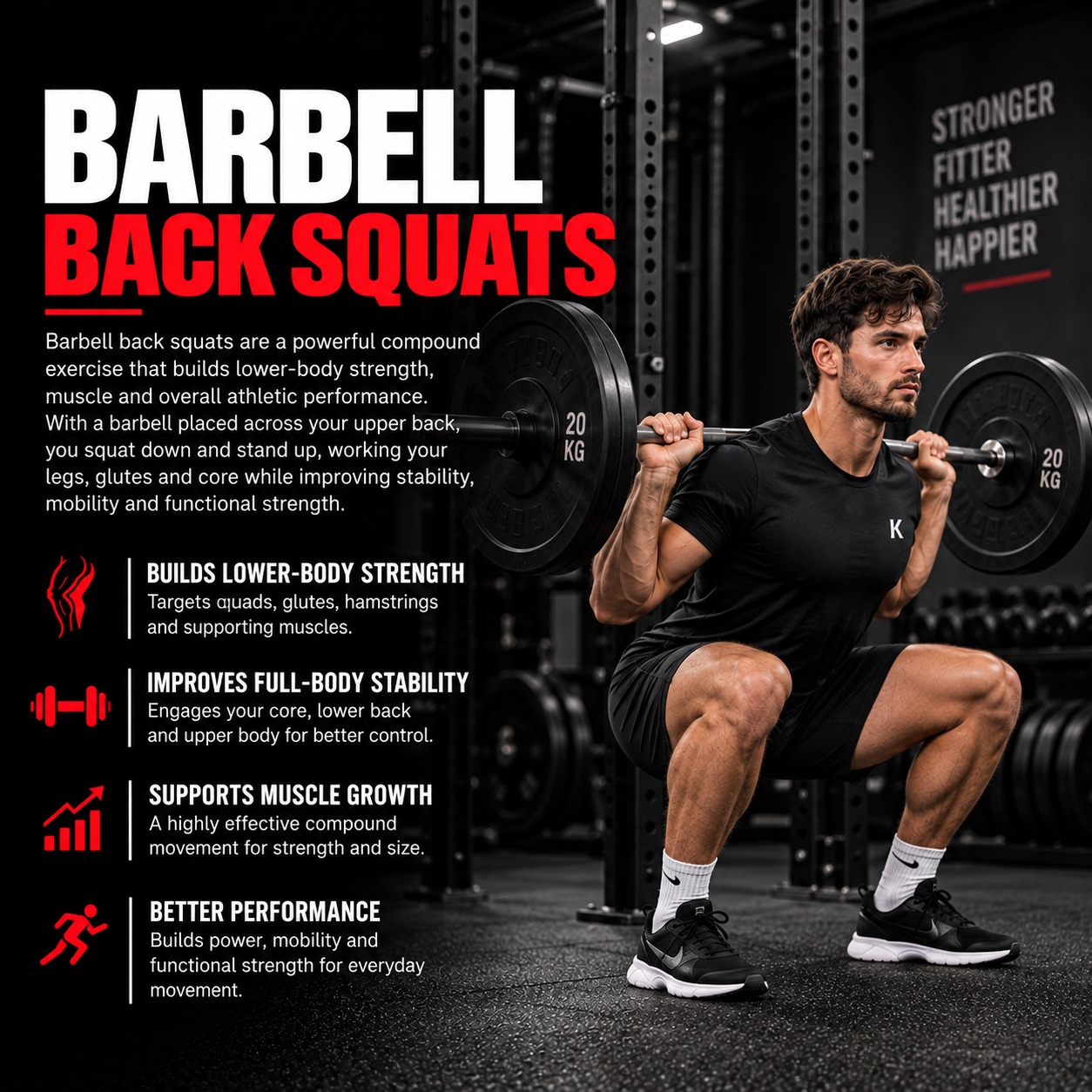
Barbell back squats are a compound strength exercise that trains the lower body while challenging the core and upper back to stabilise the body. With a barbell positioned across the upper back, you bend at the hips and knees to lower your body before driving through the floor to return to standing.
They are widely used for developing lower-body strength and muscle because the exercise allows you to progressively increase resistance while training several muscle groups together.
Good technique should come before heavy loading. Beginners can learn the movement with bodyweight or goblet squats before progressing to a barbell when they feel confident controlling the movement.
Master every exercise with expert coaching, personalised training plans, and a supportive gym environment designed to help you achieve real, lasting results.
A barbell back squat is a loaded squat performed with a barbell resting across the upper back. Unlike a bodyweight squat, the external load increases the strength and stability demands of the movement.
The exercise combines several movements at the same time:
Hip flexion and extension
Knee flexion and extension
Ankle movement
Trunk stabilisation
This makes the back squat a compound exercise, rather than an isolation movement targeting just one muscle.
The bar can generally be positioned in either a high-bar or low-bar position. Your preferred position can affect your torso angle, balance and the contribution of different muscle groups.
During a well-controlled repetition, the bar should remain balanced over your base of support, with the mid-foot acting as an important reference point for balance.
Barbell back squats primarily train the muscles of the lower body, while the core and back work hard to keep the body stable under the load.
The quadriceps at the front of the thighs help extend the knees as you stand from the bottom of the squat. They are particularly important during the upward phase.
The gluteus maximus contributes to hip extension as you drive upwards from the squat. The glutes can play a significant role in producing force, particularly as the hips extend towards standing.
The hamstrings assist with hip extension and help stabilise the knee and hip during the movement. Their role differs from that of the quadriceps because they cross both the hip and knee joints.
The adductor muscles on the inside of the thigh contribute to hip movement and stability during a squat. Their contribution can vary depending on stance, depth and individual anatomy.
Your abdominal and other trunk muscles help create stiffness around the torso. This allows you to maintain a stable position while the legs and hips produce force.
The erector spinae help maintain your spinal position under the bar. They are primarily acting as stabilisers rather than being the main muscles responsible for moving the weight.
The upper-back muscles help create a stable shelf for the bar and maintain the position of your torso throughout the repetition.
Primary movers: quadriceps, glutes, adductors and muscles involved in hip and knee extension.
Supporting and stabilising muscles: core, erector spinae and upper-back musculature.
Not every muscle works to the same degree. Your technique, bar position, stance, depth and individual structure all influence how the workload is distributed.
When performed with appropriate technique and loading, barbell back squats can offer several useful training benefits.
The exercise allows the legs and hips to work against substantial resistance, making it useful for developing general lower-body strength.
Because multiple lower-body muscles work together, back squats can be an efficient part of a programme focused on hypertrophy and overall leg development.
A barbell makes it relatively straightforward to gradually increase resistance. Progress can also come from performing more repetitions, improving technique or increasing training volume.
Holding a loaded bar while squatting requires the core and back to maintain a controlled torso position.
The movement requires the hips, knees, ankles and trunk to work together. Learning to coordinate these movements can improve overall lifting skill.
Rather than training the quadriceps, glutes and supporting muscles separately, the squat allows several areas to be trained within one movement.
Follow these steps to perform the exercise safely and consistently.
Set up the squat rack
Position the bar in the rack around upper-chest to shoulder height so you can comfortably get underneath it without standing on your toes.
Set the safety pins
If your rack has adjustable safety pins or arms, position them so they can catch the bar if you cannot complete a repetition.
Choose your bar position
Place the bar securely across your upper back. A high-bar position sits higher on the trapezius muscles, while a low-bar position sits lower across the rear shoulder area.
Take your grip
Grip the bar firmly with both hands. Your hand position should allow you to create a stable upper back without forcing your shoulders into an uncomfortable position.
Get underneath the bar
Step underneath the bar and establish a balanced position before lifting it from the rack.
Unrack the bar
Stand tall to lift the bar from the supports. Avoid taking unnecessary steps once the bar is unracked.
Step back carefully
Take a small number of controlled steps backwards and establish your stance.
Set your feet
Position your feet at a width that allows you to squat comfortably while maintaining balance. A roughly shoulder-width stance is a common starting point, but individual anatomy matters.
Set your toe angle
Allow the toes to point slightly outwards if that feels natural and helps your knees track comfortably.
Brace your core
Before descending, take a breath and brace your trunk as though preparing to absorb contact.
Begin the descent
Bend your knees and hips together, lowering your body under control.
Keep the knees tracking appropriately
Allow your knees to move in a direction that generally follows the line of your toes. Avoid deliberately forcing them into a particular position that feels unnatural.
Control your hip movement
Keep the bar and your body balanced as your hips descend. Your exact torso angle will depend on your bar position and individual proportions.
Reach an appropriate depth
Descend as far as you can while maintaining control and a stable position. Depth should suit your anatomy, mobility and training objective.
Drive upwards
Push against the floor and extend your knees and hips to return towards standing.
Finish the repetition
Stand tall without aggressively leaning backwards or overextending your spine.
Repeat with control
Maintain a consistent stance, brace and bar path throughout your set.
Set the bar at an appropriate height in the squat rack.
Position the bar securely across your upper back.
Brace your core and unrack the bar.
Take controlled steps back and establish your stance.
Bend your hips and knees to descend.
Reach a comfortable, controlled depth.
Drive through the floor to stand.
Repeat while maintaining balance and technique.
Small technical adjustments can make the movement feel considerably more controlled.
Think about maintaining balance rather than trying to force the bar into a perfectly vertical line at all costs. The bar should generally remain over the middle of your foot throughout the repetition.
Keep the upper back engaged so the bar has a secure position. Avoid allowing the bar to roll or shift during the set.
Create trunk tension before initiating each repetition. A good brace can help you maintain your torso position as the load increases.
Your knees do not need to remain behind your toes. Instead, focus on maintaining control and allowing the knees to track appropriately for your stance and anatomy.
Avoid dropping rapidly into the bottom position. A controlled descent gives you more opportunity to maintain balance and positioning.
Think about maintaining contact through the foot rather than shifting excessively onto your toes or heels.
Use the mid-foot as a useful reference point and avoid unnecessary forward or backward movement of the bar.
Do not copy another lifter's exact foot position. Hip structure, limb length, mobility and training goals can all affect what stance feels most effective.
There is no universally superior bar position. Both styles can be effective, and the better choice depends on your goals, structure and preference.
In a high-bar squat, the bar sits higher on the upper trapezius area.
This position commonly allows for a more upright torso and can place considerable emphasis on the quadriceps while still training the glutes and other lower-body muscles.
A high-bar position may suit lifters who prefer a more upright squat or want to use the movement as part of a general leg-training programme.
In a low-bar squat, the bar sits lower across the rear shoulder area.
This typically involves a greater forward torso inclination and can increase the contribution of the hips and posterior-chain muscles. It is commonly used in powerlifting because it can allow experienced lifters to move substantial loads efficiently.
Neither style is automatically better. The appropriate position is the one that allows you to train towards your goal while maintaining a secure and controlled movement.
There is no single depth that works identically for every lifter.
Parallel is commonly used to describe a squat position where the thighs reach approximately parallel to the floor. However, your achievable depth can be influenced by:
The goal should be to use a depth you can control without sacrificing your overall position.
If you need to reduce the depth temporarily to maintain good technique, that can be appropriate. Similarly, partial-range squats are not automatically ineffective; they may have a specific purpose within a training programme.
Avoid forcing depth simply because another person can squat deeper.
Breathing and bracing become increasingly important as the load gets heavier.
Before descending:
Take a controlled breath into your abdomen and trunk.
Brace your core as if you are preparing to resist a force.
Maintain that tension as you descend and begin the ascent.
Complete the repetition and reset your breathing as appropriate before the next rep.
For lighter sets, breathing can generally be less demanding and may feel more natural. Heavier sets often require greater attention to bracing and breathing strategy.
The exact breathing approach can vary with the load, repetitions and individual training style.
1. Starting With Too Much Weight
What goes wrong: The load is too heavy to control properly.
Why it matters: Excessive loading can cause technique to deteriorate and make the movement unnecessarily difficult.
How to correct it: Reduce the weight and rebuild your technique with a manageable load.
2. Setting the Bar Too High or Too Low
What goes wrong: You have to reach awkwardly to unrack the bar.
Why it matters: An unsuitable rack height can make the setup less stable.
How to correct it: Adjust the supports so you can unrack the bar without excessive movement.
3. Losing Core Tension
What goes wrong: Your torso becomes loose or collapses during the squat.
Why it matters: A stable trunk helps you transfer force between the lower body and bar.
How to correct it: Practise breathing and bracing before each repetition.
4. Knees Collapsing Inwards
What goes wrong: The knees move substantially inwards relative to the foot during the movement.
Why it matters: This can indicate a loss of control or poor coordination.
How to correct it: Reduce the load if necessary and practise controlled repetitions while allowing the knees to track naturally.
5. Heels Lifting Unnecessarily
What goes wrong: The heels lose contact with the floor.
Why it matters: This can affect balance and stability.
How to correct it: Review your stance, foot pressure and ankle mobility rather than simply forcing the heels down.
6. Losing Balance Over the Mid-Foot
What goes wrong: The body shifts excessively forwards or backwards.
Why it matters: Unnecessary movement can make the lift less efficient.
How to correct it: Reduce the load and practise keeping the bar balanced over the middle of the foot.
7. Cutting Depth Because the Weight Is Too Heavy
What goes wrong: You squat progressively shallower as fatigue increases.
Why it matters: Your range of motion may no longer match your intended training goal.
How to correct it: Use a load that allows you to reach your intended depth with control.
8. Descending Without Control
What goes wrong: You drop rapidly into the bottom position.
Why it matters: It can make it harder to maintain balance and positioning.
How to correct it: Use a controlled descent and focus on maintaining tension.
9. Taking Too Many Steps After Unracking
What goes wrong: You walk backwards several steps while holding the bar.
Why it matters: Extra movement wastes energy and creates more opportunities to lose balance.
How to correct it: Practise a consistent, minimal walkout.
10. Ignoring Safety Pins
What goes wrong: The rack is used without properly positioned safety supports.
Why it matters: Safety equipment is particularly important when training with challenging loads.
How to correct it: Set the pins appropriately before beginning your working sets.
11. Copying Someone Else's Stance Exactly
What goes wrong: You force your feet into a position that does not suit your body.
Why it matters: Individual proportions and mobility differ.
How to correct it: Experiment with small changes to stance width and toe angle while maintaining control.
Beginners can learn barbell back squats, but there is no requirement to start with a heavily loaded bar.
First become comfortable with the basic squat pattern. Bodyweight squats and Goblet Squats can be useful ways to practise controlling the hips, knees and trunk.
Once you are comfortable, you can introduce an unloaded barbell or a light load.
Beginners should focus on:
Learning the setup
Understanding the bar position
Establishing a repeatable stance
Bracing effectively
Controlling the descent
Finding a comfortable depth
Using the squat rack correctly
Learning how to use safety pins
Increasing resistance gradually
Recording a set from the side can also help you review your movement, although feedback from a suitably qualified coach can be particularly useful.
There is no single correct starting weight for everyone.
The appropriate load depends on your:
Training experience
Target repetitions
Current strength
Training objective
Technique
Ability to maintain control
Perceived effort
For a beginner, the best starting point is a weight that allows you to practise the movement confidently without sacrificing technique.
As you become more experienced, you can select loads appropriate for strength, hypertrophy or general fitness.
Technique should remain the limiting factor before the weight on the bar becomes the priority.
Your sets and repetitions should reflect your training objective and wider programme.
A common approach is to use lower repetitions with relatively heavier loads, such as approximately 3–6 repetitions per set.
Moderate repetition ranges, such as approximately 6–12 repetitions, can be useful when combined with appropriate effort and training volume.
Moderate loads and approximately 8–15 repetitions can work well for many general training programmes.
These are examples rather than mandatory prescriptions. Your experience, programme structure, recovery and training goals should determine the most suitable approach.
Progressive overload does not necessarily mean adding weight every time you train.
You can progress by:
Gradually increasing the load
Adding repetitions within your chosen range
Improving your technique
Increasing training volume
Performing repetitions with greater consistency
Improving control and range of motion
Reducing unnecessary movement
For example, if you can consistently complete your target repetitions with good technique, you may eventually increase the load by a small amount.
If adding weight causes your form to deteriorate significantly, staying at the same weight while improving execution can still represent useful progress.
A well-organised setup is an important part of safe strength training.
Before your working sets:
Check that the bar is securely positioned in the rack.
Set the safety pins at an appropriate height.
Use a manageable load.
Perform an appropriate warm-up.
Make sure the lifting area is clear.
Establish your stance before beginning.
Use a spotter or appropriate safety setup when necessary.
Avoid attempting failed repetitions without suitable safety provisions.
Stop or reduce the load if your technique deteriorates significantly.
If you have an existing injury, persistent pain or a medical condition that affects exercise, seek advice from an appropriately qualified healthcare or fitness professional before performing loaded squats.
A traditional back-squat variation where the bar rests higher on the upper back. It often encourages a relatively upright torso.
The bar sits lower across the rear shoulder area and generally involves a greater torso inclination.
Pause briefly at the bottom of the squat before standing. This can help develop control and strength from the paused position.
Perform the lowering phase at a deliberately controlled speed. This can increase the technical and muscular demands without simply adding more weight.
The lifter squats towards a box or bench to provide a consistent depth reference. The box should be used as a technique tool rather than something to crash onto.
A narrower foot position can change the movement demands and may suit some lifters depending on their structure and goals.
A wider stance can alter hip positioning and may allow some lifters to find a comfortable and controlled squat position.
Back squats are useful, but they are not compulsory for developing strong legs.
A dumbbell or kettlebell is held in front of the body. This can be an approachable option for learning the squat pattern.
The bar is positioned across the front of the shoulders, typically requiring a more upright torso.
A machine-based squat variation that provides external support and can be useful when you want to train the legs without balancing a free barbell.
The leg press allows you to train knee and hip extension while your back is supported by the machine.
A single-leg exercise that challenges the quadriceps, glutes and balance while allowing each leg to work independently.
Dumbbells can provide a practical alternative when a barbell or squat rack is unavailable.
The best alternative depends on your goals, experience, equipment and individual preferences.
Barbell back squats primarily train the quadriceps, glutes and adductors. The hamstrings, core, erector spinae and upper back also contribute to movement and stability.
Yes. They can be an effective exercise for developing lower-body muscle when combined with appropriate resistance, repetitions, training volume and recovery.
Yes. The exercise is well suited to strength training because the barbell allows resistance to be progressively increased while training several major muscle groups together.
Squat to a depth that suits your anatomy, mobility, training goal and ability to maintain control. Parallel is a common reference point, but everyone does not need to use exactly the same depth.

 Blogs
Blogs