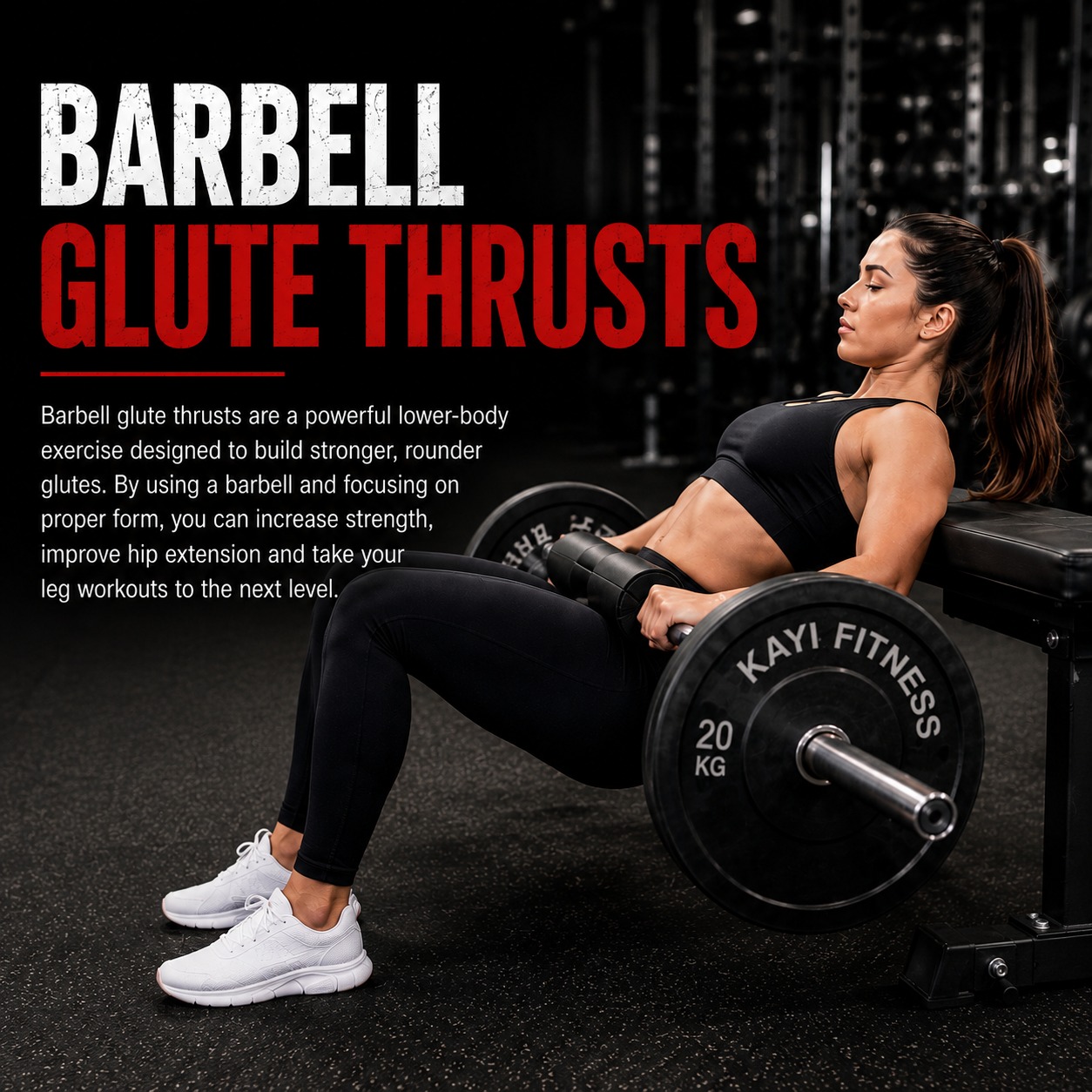
Barbell glute thrusts are a powerful lower-body exercise for building stronger, more developed glutes. By adding a barbell to the movement, you can gradually increase the resistance and challenge your glutes through hip extension.
The movement is relatively simple, but small details such as bench position, foot placement and how you finish each repetition can make a noticeable difference. When performed with control, barbell glute thrusts can be a valuable part of a lower-body or glute-focused workout.
Master every exercise with expert coaching, personalised training plans, and a supportive gym environment designed to help you achieve real, lasting results.
Barbell glute thrusts are a loaded hip-extension exercise performed with your upper back supported against a bench. A barbell rests across the front of your hips while you drive your hips upwards from the floor.
At the top of each repetition, your hips should be fully extended and your glutes should be doing most of the work. You then lower your hips under control before repeating the movement.
You may also hear this exercise called a barbell hip thrust. The two names are commonly used for the same basic movement.
Unlike a standard glute bridge, where your shoulders and upper back remain on the floor, the glute thrust uses a bench to give your upper body a raised position. This allows a greater range of hip movement and makes it easier to progressively load the exercise.
The barbell also makes progressive overload straightforward. Once you can perform your chosen repetitions comfortably with good technique, you can gradually increase the resistance.
Gluteus Maximus
Hamstrings, Quadriceps, Adductors, Core and Erector Spinae
The gluteus maximus is the main muscle targeted during barbell glute thrusts. It is responsible for powerful hip extension, particularly as you drive your hips towards the top position. If your technique is right, your glutes should feel like they are doing most of the work rather than your lower back.
Your hamstrings assist with hip extension and help control the movement. They contribute to the exercise, but they should not become the main focus.
The quadriceps help stabilise the knee and contribute to maintaining your position as you drive through your feet.
The muscles on the inside of your thighs can assist with hip extension and help provide stability throughout the movement.
Your core and spinal muscles work to keep your torso stable while you move through hip extension. They are supporting the exercise rather than being the primary target.
Build Stronger Glutes
Support Glute Muscle Growth
Improve Hip Extension Strength
Add Progressive Overload
Strengthen Your Lower Body
Improve Glute Training Control
Build Stronger Glutes: Barbell glute thrusts allow you to train the glutes against external resistance, making them useful for developing lower-body strength.
Support Glute Muscle Growth: Because the movement can be progressively loaded, it can be included in a structured resistance-training programme aimed at building muscle.
Improve Hip Extension Strength: The exercise trains your ability to extend the hips against resistance, an important movement pattern in lower-body strength training.
Add Progressive Overload: You can gradually increase the challenge by adding weight, increasing repetitions or improving your control rather than simply performing the same workout every time.
Strengthen Your Lower Body: Although the glutes are the main target, the hamstrings, quadriceps, adductors and core all contribute to a controlled repetition.
Improve Glute Training Control: The top position gives you an opportunity to learn how to finish hip extension properly without relying on momentum.
Set Up the Bench: Place a sturdy bench behind you and make sure it will not move during the exercise. Sit on the floor with your upper back positioned against the edge of the bench.
Position the Barbell: Place the barbell across your hips. A barbell pad can make the exercise more comfortable, particularly as you begin using heavier loads.
Set Your Upper Back: Lean your upper back against the bench and keep your feet planted on the floor. Your shoulders should remain supported while your hips are free to move.
Find Your Foot Position: Bring your feet into a position that allows your shins to be roughly vertical near the top of the movement. Everyone's proportions are slightly different, so use this as a guide rather than forcing an exact stance.
Brace Before You Lift: Take a breath, brace your core and keep your ribs controlled. Your starting position should feel stable before you begin driving the hips upwards.
Drive Your Hips Up: Push through your feet and extend your hips, lifting the barbell upwards. Think about moving your hips rather than simply lifting the bar with your lower back.
Squeeze at the Top: Continue until your hips reach full extension. Briefly squeeze your glutes at the top while keeping your ribs and pelvis controlled. You do not need to push your hips excessively high.
Lower With Control: Slowly lower your hips towards the floor while keeping the barbell stable. Avoid dropping into the bottom position. Once you have controlled the descent, begin the next repetition.
Keep your upper back stable. Your upper back should stay supported against the bench. If you are constantly shifting position, reduce the load and reset your setup.
Keep your ribs controlled. Avoid flaring your ribs and aggressively arching your lower back to reach the top. The goal is hip extension, not creating a huge backbend.
Drive through your feet. Push firmly through the floor rather than trying to lift the bar using your back.
Watch your knee position. Your knees should remain controlled and track naturally in line with your feet rather than collapsing inward.
Finish with your hips. At the top, think about bringing your hips into extension and squeezing your glutes. You do not need to lift your chest or throw your head backwards.
Pause briefly at the top. A short pause can help remove momentum and make it easier to feel whether you are actually finishing the movement with your glutes.
Control the descent. The lowering phase should not be an afterthought. Lowering steadily helps you maintain position and keeps the exercise deliberate.
Use a barbell pad if needed. A pad can make the bar more comfortable across the hips, especially when increasing the load.
Loading the bar heavily before you have mastered the movement often leads to shortened repetitions, poor positioning and excessive momentum.
Fix: Reduce the weight and make every repetition controlled before increasing the load again.
Some people try to reach higher by arching their lower back instead of extending their hips.
Fix: Keep your core braced and ribs controlled. Finish the movement by squeezing your glutes rather than pushing your chest upwards.
A bench that is too far away, too close or unstable can make the movement awkward and affect your range of motion.
Fix: Take time to set the bench correctly before loading the bar.
Foot position affects which muscles contribute and how comfortable the movement feels.
Fix: Adjust your feet until you can reach the top position with good hip extension and controlled knees.
Using momentum to move the bar makes it harder to control the exercise.
Fix: Pause briefly at the top and lower the weight steadily.
Dropping quickly into the bottom position can cause you to lose your setup.
Fix: Treat the lowering phase as part of the repetition and maintain control throughout.
If your lower back is doing most of the work, the load may be too heavy or your hip position may need adjusting.
Fix: Reduce the resistance, brace your core and focus on driving the hips forward while squeezing the glutes.
There is no single weight that is right for everyone.
A beginner may start with bodyweight practice or a very light load, while a more experienced lifter may eventually use substantially heavier resistance. Your training experience, strength, goals and technique all influence the appropriate load.
The best starting point is a weight that allows you to complete your planned repetitions without losing control. You should be able to maintain your setup, reach a consistent top position and lower the bar smoothly.
As the exercise becomes easier, increase the resistance gradually. If adding weight causes your technique to change significantly, the jump is probably too large.
If you're new to glute thrusts, there is no need to rush towards a heavy barbell.
Start by learning the movement without weight. Practise setting your upper back against the bench, finding a comfortable foot position and controlling your hips through the full movement.
Once the movement feels natural, introduce a manageable load. Your first goal should be consistency rather than impressive numbers.
Start with a sensible number of repetitions that you can perform with good technique. Over time, you can gradually increase the resistance as your strength and confidence improve.
If you're unsure about your setup, asking a qualified trainer to check your positioning can also be useful.
Once you are comfortable with the standard movement, these variations can help you adjust the challenge and keep your training varied.
Barbell glute thrusts are primarily useful for strengthening and developing the glutes. They also train hip extension while involving supporting muscles such as the hamstrings, quadriceps, adductors and core.
Yes. They can be an effective exercise for glute development because the movement can be performed against progressively increasing resistance. Consistent training, suitable volume and appropriate recovery are still needed for long-term muscle growth.
The barbell should sit across the hip area rather than directly on the softest part of your abdomen. A suitable barbell pad can improve comfort and make heavier sets easier to manage.
Lower-back involvement can increase if you overarch your spine, lose your core position or use more weight than you can control. Try reducing the load and focus on controlled hip extension without pushing your ribs upwards.
How often you perform them depends on your overall training programme, recovery and goals. For many people, including a glute thrust variation in one or two lower-body sessions each week can be a sensible starting point, provided the total training workload is appropriate.

 Blogs
Blogs