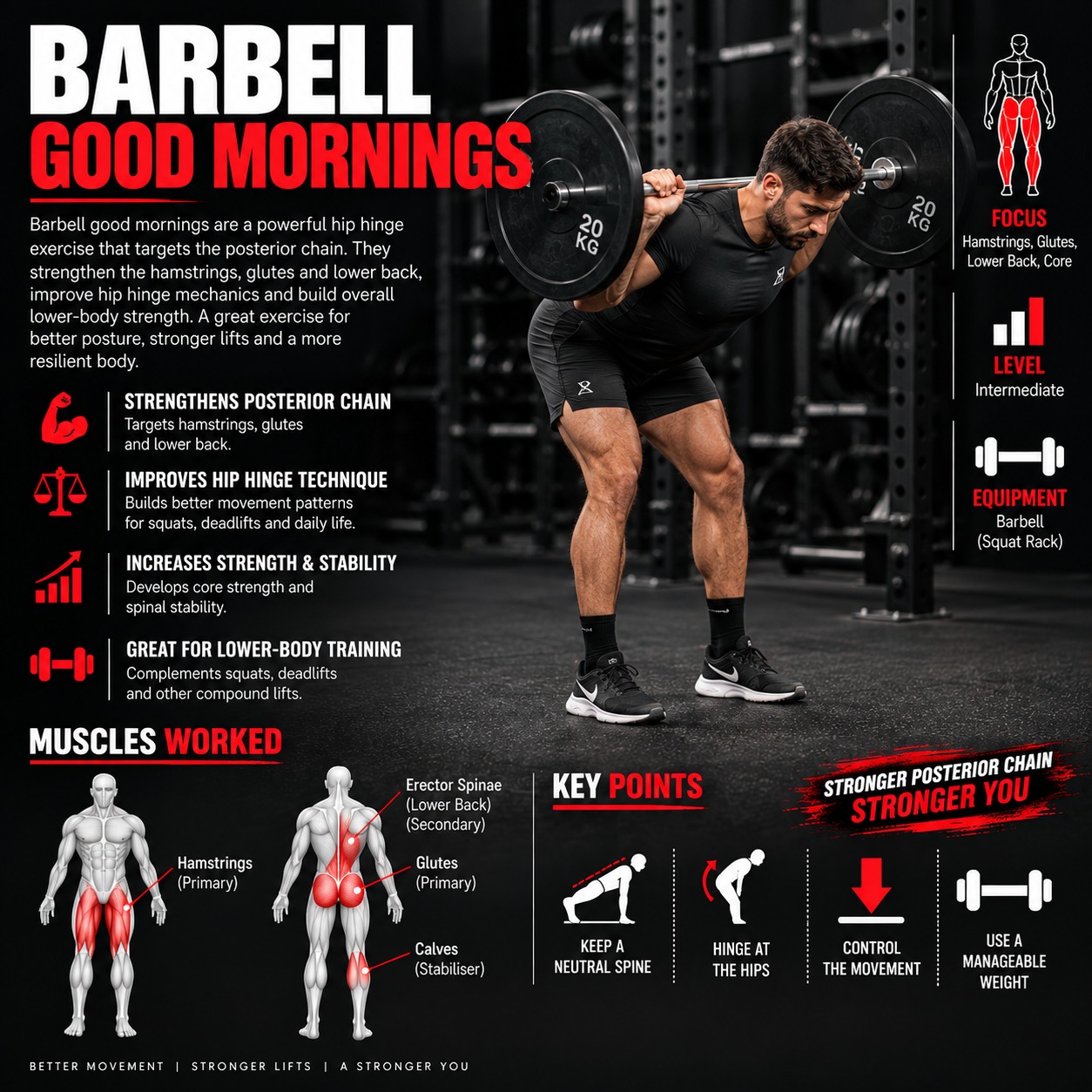
The barbell good morning is a hip-hinge exercise that trains the posterior chain, with a strong emphasis on the hamstrings, glutes and lower back.
A barbell is positioned across the upper back while you hinge forwards from the hips. The exercise requires good control and body awareness, so beginners should learn the movement with bodyweight or a very light load before progressing.
Good mornings can complement other lower-body exercises such as squats and deadlifts because they reinforce the hip-hinge movement pattern.
Master every exercise with expert coaching, personalised training plans, and a supportive gym environment designed to help you achieve real, lasting results.
| Detail | Information |
|---|---|
| Exercise Type | Compound |
| Main Muscles | Hamstrings, glutes |
| Secondary Muscles | Erector spinae, core |
| Equipment | Barbell, squat rack |
| Difficulty | Intermediate |
| Movement Pattern | Hip hinge |
| Best For | Posterior-chain strength |
The hamstrings lengthen as you hinge forwards and help extend your hips as you return to standing.
Your glutes work strongly during the upward phase as your hips move forwards.
The erector spinae help maintain a stable spinal position throughout the exercise.
Your core helps keep your torso stable while the barbell is positioned across your upper back.
Good mornings train several muscles on the back of the body at once.
The exercise reinforces the ability to move from the hips while maintaining a controlled torso.
It can complement exercises such as squats, Romanian deadlifts and conventional deadlifts.
The slow lowering phase creates a controlled stretch through the hamstrings.
Place a barbell securely across your upper back in a squat-rack position.
Stand with your feet around hip-width apart.
Brace your core and keep your chest controlled.
Unlock your knees slightly.
Push your hips backwards and begin hinging forwards.
Keep your spine neutral as your torso moves towards the floor.
Continue until you feel a strong hamstring stretch while maintaining good form.
Pause briefly at the bottom.
Drive your hips forwards and squeeze your glutes.
Return to an upright standing position without leaning backwards.
Start with a light weight.
Keep the bar secure across your upper back.
Maintain a neutral spine.
Push your hips backwards.
Keep a slight bend in your knees.
Do not chase excessive depth.
Control both the lowering and lifting phases.
Using too much weight
Good mornings require control rather than maximum loading.
Rounding the spine
Stop the movement before your posture breaks down.
Bending the knees excessively
Keep the knees soft but avoid turning the movement into a squat.
Going too deep
Your range of motion should be determined by your mobility and ability to maintain good technique.
Overextending at the top
Finish tall rather than pushing the hips excessively forwards.
A barbell good morning is a compound hip-hinge exercise performed with a barbell across the upper back. It primarily trains the hamstrings and glutes while also engaging the lower back and core.
Barbell good mornings mainly work the hamstrings, glutes and erector spinae. Your core also works to help stabilise your torso while you perform the hip hinge.
Yes. Barbell good mornings place the hamstrings under tension as you hinge forwards and can be included in a posterior-chain or lower-body training programme.
Start with a light weight that allows you to maintain a neutral spine and controlled hip hinge. Good morning technique is more important than lifting a heavy load, particularly when you are learning the exercise.
Beginners should first learn the hip-hinge movement with bodyweight or a very light load. Once you can control the movement with good technique, you can gradually introduce a barbell and increase the resistance over time.

 Blogs
Blogs