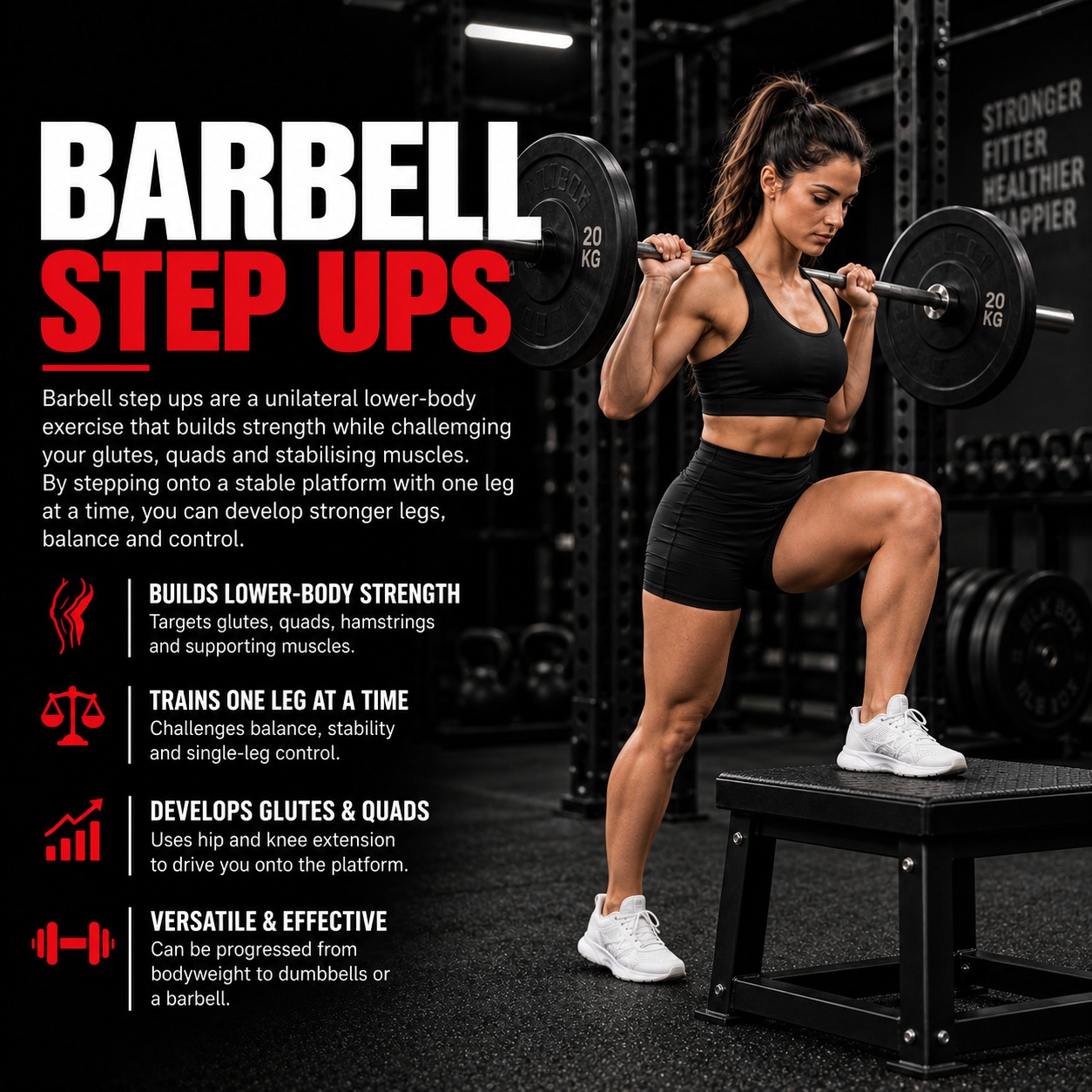
Barbell step ups are a unilateral lower-body exercise that trains one leg at a time as you step onto a stable elevated platform. With a barbell positioned across your upper back, the movement increases resistance and challenges the glutes, quadriceps and other lower-body muscles.
When performed with controlled barbell step up form, this exercise can help develop lower-body strength, balance, stability and coordination. It is also a useful addition to a leg workout when you want to train each side independently rather than relying entirely on bilateral exercises such as squats.
Beginners can learn the pattern with bodyweight or dumbbell step ups before progressing to a barbell once they feel confident controlling the movement.
Master every exercise with expert coaching, personalised training plans, and a supportive gym environment designed to help you achieve real, lasting results.
| Exercise | Barbell Step Ups |
| Primary muscles | Gluteus maximus and quadriceps |
| Secondary muscles | Hamstrings, calves, core and hip stabilisers |
| Exercise type | Unilateral compound exercise |
| Equipment | Barbell; stable platform, box or step |
| Difficulty | Intermediate |
| Movement pattern | Unilateral knee- and hip-dominant movement |
Barbell step ups are a unilateral lower-body compound exercise performed by stepping onto an elevated platform while supporting resistance with a barbell across your upper back.
The movement starts with one foot placed firmly on the platform. You then drive through that elevated foot to extend the hip and knee, bringing your body up until you are standing on the platform. The trailing leg follows without providing excessive assistance, before you step back down under control.
Barbell step ups differ from other lower-body exercises in a few key ways:
Unlike bodyweight step ups, the barbell provides additional external resistance
Compared with dumbbells, a barbell allows substantial loading but requires managing weight across your upper back
Unlike squats, step ups require you to produce force with one elevated leg at a time
Unlike lunges, step ups involve overcoming the height of a platform rather than moving into a split stance
Beginners may find bodyweight or dumbbell variations easier to learn initially, since balance, setup and technique become more important once a barbell is added.
The main muscles involved are the gluteus maximus and quadriceps, with several other muscles helping to stabilise and control the movement.
The glutes contribute strongly as you extend the hip and drive your body upwards. Maintaining a stable position and choosing a suitable platform height can help you train the glutes effectively without relying on excessive momentum.
The quadriceps work to extend the knee as you rise onto the platform. They are particularly important during the initial drive upwards and when controlling the position of the knee.
The hamstrings assist with hip extension and help contribute to control around the hip and knee throughout the movement.
The calf muscles help stabilise the ankle and foot as you push into the platform and control your body during the ascent and descent.
Your abdominal and other trunk muscles work to keep your torso stable while the barbell is supported across your upper back. Good core bracing can make it easier to maintain a controlled movement.
The muscles around the hips help control the pelvis and knee as you balance on one leg. This is one reason step ups can provide a different training challenge from bilateral lower-body exercises.
Primary movers: gluteus maximus and quadriceps.
Supporting and stabilising muscles: hamstrings, calves, core and hip stabilisers.
Not every muscle works to the same degree. Platform height, technique, load and individual structure all influence how the workload is distributed.
When performed with appropriate technique and loading, barbell step ups can offer several useful training benefits.
The working leg must produce enough force to raise your body onto the platform. Adding resistance progressively can make the movement a useful strength exercise within a lower-body programme.
The glutes and quadriceps perform much of the work during the step-up, making barbell step ups useful when you want additional training volume for the major muscles of the legs.
As a unilateral exercise, step ups allow each leg to work independently, providing a useful alternative to exercises where both legs contribute simultaneously.
Standing and moving from a single-leg position requires control around the foot, ankle, knee, hip and trunk. This demand can increase as the load becomes heavier.
The movement pattern resembles climbing stairs or stepping onto a raised surface, which can complement other lower-body movements in a well-rounded training programme.
Training each leg separately can make differences in strength, coordination or control more noticeable, giving you a chance to train each side independently.
Follow these steps to perform the exercise safely and consistently. Practise with bodyweight first if you are unfamiliar with step ups.
Choose a stable platform
Place a stable training platform, box or step in front of you and check it will not move during the exercise.
Position the barbell
Position a barbell securely across your upper back, similar to a back squat setup.
Take your grip
Use a comfortable grip and keep the bar stable throughout the exercise.
Set your stance
Stand facing the platform with your feet positioned comfortably beneath you.
Brace your core
Brace your core and maintain a controlled, upright torso before you begin.
Plant the working foot
Place one entire foot firmly on the platform, with your heel fully supported.
Drive through the elevated foot
Push firmly into the platform using the working leg to begin the ascent.
Extend the knee and hip
Raise your body until you reach a standing position on the platform.
Bring the trailing leg up
Bring the other foot onto the platform without aggressively pushing off the floor.
Maintain your posture
Keep your torso stable and avoid excessive forward or sideways movement.
Control the descent
Carefully lower yourself back towards the floor rather than dropping from the platform.
Repeat the movement
Perform the required repetitions before changing legs, or alternate sides if that suits your programme. The leading leg should perform most of the work — using the trailing leg to launch yourself upwards makes the exercise easier but reduces the emphasis on the working leg.
Set a stable platform in front of you.
Position the barbell securely across your upper back.
Place one foot firmly on the platform.
Brace your core and drive through the elevated foot.
Extend the knee and hip to stand on the platform.
Bring the trailing leg up under control.
Lower yourself back down with control.
Repeat for the desired reps, then switch legs.
Good barbell step up technique is about control rather than simply getting onto the platform as quickly as possible.
Your entire working foot should be on the platform. The heel should not hang off the edge.
Think about pushing the platform away rather than jumping onto it.
Keep the knee tracking in a controlled direction rather than allowing it to collapse excessively inward.
Swinging the body or jumping onto the box can reduce muscular control.
A stable trunk helps you manage the barbell and maintain balance throughout the movement.
The lowering phase should be deliberate rather than a free fall.
The floor leg should not become the main source of upward force.
Good movement is more valuable than forcing extra repetitions with poor form. Start with manageable resistance and use an appropriate platform height.
There is no single platform height that is perfect for everyone. The appropriate height depends on several factors:
For beginners, a relatively low platform is often a sensible starting point. You should be able to place your working foot securely on the platform and drive upwards without excessive momentum or losing control.
A platform that is too high may force you into excessive hip or knee flexion and make it harder to maintain control.
Increasing the height simply to make the exercise look harder is not necessarily productive. Choose a height that allows a useful range of motion while keeping the working leg stable.
1. Using Too Much Weight
What goes wrong: The load is too heavy to control properly.
Why it matters: Heavy loading can make it difficult to maintain balance and proper technique.
How to correct it: Start with a resistance level that allows controlled repetitions.
2. Pushing Off the Floor
What goes wrong: The trailing leg pushes strongly from the floor.
Why it matters: The working leg ends up doing less of the work.
How to correct it: Focus on driving through the elevated foot instead.
3. Choosing a Platform That Is Too High
What goes wrong: The platform height exceeds what you can control.
Why it matters: An excessively high platform can compromise your position and make the exercise unnecessarily difficult.
How to correct it: Choose a height that matches your current ability.
4. Losing Balance
What goes wrong: You wobble or shift off the platform mid-rep.
Why it matters: Poor setup, excessive loading and rushing repetitions can all make balance more difficult.
How to correct it: Slow the movement down and reduce the load if necessary.
5. Dropping Quickly From the Platform
What goes wrong: The descent is rushed or uncontrolled.
Why it matters: The descent is part of the exercise, not an afterthought.
How to correct it: Lower yourself with control rather than simply stepping or falling down.
6. Allowing the Knee to Collapse Inward
What goes wrong: The working knee drifts inward during the ascent.
Why it matters: It can reduce control and increase strain around the knee.
How to correct it: Maintain controlled knee alignment, and reduce the load or platform height if you cannot do this consistently.
7. Using Momentum
What goes wrong: You swing your body or jump onto the platform.
Why it matters: This shifts the emphasis away from controlled strength production.
How to correct it: Slow the tempo down and focus on driving through the working leg.
8. Increasing Weight Before Mastering Technique
What goes wrong: Load is added before the movement is consistent.
Why it matters: Progressive overload works best when the movement remains consistent.
How to correct it: Build your technique first, then increase resistance gradually.
Barbell step ups and squats both train the lower body, but they have important differences. Neither exercise needs to replace the other — they can be programmed together to provide different lower-body training stimuli.
A predominantly bilateral movement, meaning both legs work together during each repetition. Squats allow substantial loading and are commonly used as a major strength exercise, with a more symmetrical setup.
A unilateral movement, with one leg positioned on an elevated platform and responsible for driving the body upwards. Step ups place greater emphasis on single-leg coordination, balance and stability, requiring greater control from the working side.
Step ups and lunges are both useful unilateral lower-body exercises, but the movement patterns differ.
The working leg starts on an elevated platform and drives the body upwards, emphasising the action of stepping upwards and overcoming the platform height.
Both feet remain on the floor while you move into and out of a split stance. Reverse lunges can be easier to control since stepping backwards reduces forward momentum, while walking lunges add continuous movement between legs.
Barbell step ups may be a good choice when you want to emphasise the action of stepping upwards, while lunges provide more traditional split-stance training.
The appropriate volume depends on your training experience, goal, resistance, exercise order and overall programme.
Start with manageable volume and prioritise technique. If you have not performed loaded step ups before, bodyweight practice can help you learn the movement.
Use moderate resistance and progressively increase repetitions, sets or load while maintaining consistent form.
Lower repetitions with a challenging but controlled resistance can be appropriate. Longer rest periods may also be useful.
Moderate repetitions, sufficient training volume and controlled execution can make barbell step ups a useful part of a muscle-building programme.
Always consider how the exercise fits into your complete lower-body workout rather than viewing sets and repetitions in isolation.
Progressive overload does not always mean immediately adding more weight.
A sensible progression could look like this:
Master the technique with bodyweight or a light load
Increase repetitions while maintaining good form
Add sets if additional training volume is appropriate
Increase resistance gradually once your current load becomes manageable
Improve control by making each repetition more deliberate
Adjust platform height when appropriate if your strength and mobility allow it
Do not use a higher box as a substitute for progressive resistance. A bigger platform does not automatically produce a better training stimulus.
A few simple precautions can make the exercise easier to perform safely.
Use a stable platform that will not move during the exercise.
Make sure the barbell is securely positioned before starting.
Choose a resistance level you can control.
Leave sufficient space around the platform.
Keep your repetitions controlled.
Avoid rushing the descent.
Stop the set if your technique starts to break down.
Consider appropriate supervision when learning a heavily loaded barbell movement.
If an exercise causes pain or you have a relevant injury or medical concern, seek advice from an appropriately qualified healthcare professional. The aim is to make each repetition controlled and repeatable rather than simply completing the movement with as much weight as possible.
A simple option for beginners learning the basic movement pattern before introducing external resistance.
Holding dumbbells at your sides allows you to add resistance while avoiding the barbell position across your upper back.
A front-loaded variation changes how the resistance is positioned and can increase the demand on your trunk and lower body.
A lower platform generally reduces the range of motion and can be useful for learning technique or managing the difficulty of the exercise.
A higher platform increases the required range of motion, but it should only be used when you can maintain good control and positioning.
Stepping onto the platform from the side changes the movement direction and introduces a different coordination and stability challenge.
If barbell step ups are not suitable for your workout or available equipment, several exercises can train similar lower-body qualities.
Useful for unilateral lower-body strength while keeping both feet in contact with stable surfaces.
A practical unilateral exercise that can be performed with bodyweight, dumbbells or other resistance.
Useful when you want continuous unilateral leg work combined with movement and balance.
A straightforward squat variation that is often easier to learn than a loaded barbell squat.
A barbell squat variation that provides substantial lower-body training while requiring an upright torso position.
A machine-based option that allows lower-body resistance training without requiring the same balance demands as a step up.
A particularly direct alternative when you want to retain the step-up movement but change the loading method.
The best alternative depends on your goals, experience, equipment and individual preferences.
Barbell step ups can be useful for intermediate and advanced lifters who are comfortable with loaded lower-body exercises and want to include unilateral training.
Beginners can also work towards them, but it is sensible to become familiar with bodyweight step ups first. Once you can consistently control the movement, you can gradually introduce resistance.
They may be useful for:
Lifters developing lower-body strength
People looking for unilateral leg exercises
Those wanting additional glute or quad training
Athletes incorporating single-leg strength work
Experienced gym users looking for another lower-body exercise
Your exercise selection should ultimately reflect your experience, equipment, goals and ability to perform the movement safely.
Barbell step ups primarily work the gluteus maximus and quadriceps. The hamstrings, calves, core and muscles around the hips also contribute by helping with hip and knee movement, balance and stability. Because the exercise is performed one leg at a time, it also requires each side to control the body independently.
Yes, barbell step ups can be a useful exercise for glute development. The glutes contribute significantly as you extend the hip and drive your body onto the platform. To train them effectively, use a suitable platform height, keep the working foot firmly planted and avoid relying heavily on the trailing leg for momentum.
Yes. The quadriceps are heavily involved in extending the knee as you drive upwards onto the platform. Barbell step ups can therefore be included alongside other quad-focused exercises such as squats, split squats and leg presses. The amount of emphasis you feel can vary depending on your individual technique, platform height and programme.

 Blogs
Blogs