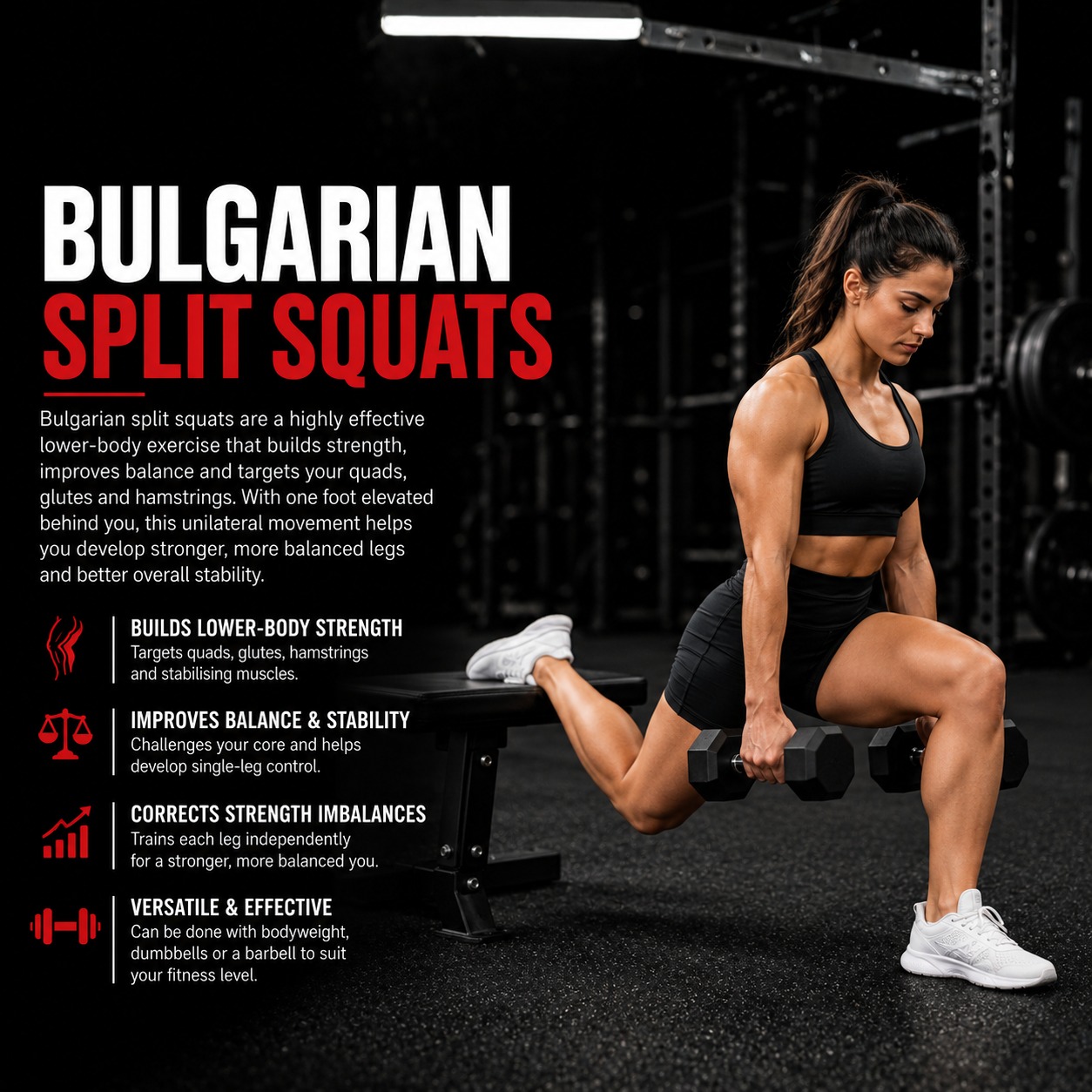
Bulgarian split squats are a unilateral lower-body exercise where your rear foot is elevated behind you while your front leg performs most of the work. They train the quads and glutes while also challenging the hamstrings, calves, core and muscles responsible for balance and stability.
Because each leg works largely independently, Bulgarian split squats can be useful for developing lower-body strength, improving single-leg control and adding variety to a leg training programme.
Master every exercise with expert coaching, personalised training plans, and a supportive gym environment designed to help you achieve real, lasting results.
| Exercise | Bulgarian Split Squats |
| Primary muscles | Quadriceps and glutes |
| Secondary muscles | Hamstrings, calves, adductors, abductors and core |
| Exercise type | Unilateral compound exercise |
| Equipment | Bench, box or elevated platform; optional weights |
| Difficulty | Intermediate |
| Movement pattern | Squat / unilateral knee-dominant movement |
Bulgarian split squats are a variation of the split squat performed with the rear foot elevated on a bench, box or similar stable platform.
Unlike a standard split squat, where both feet remain on the floor, the elevated rear foot changes the balance requirements and allows the front leg to take most of the workload.
The exercise is sometimes referred to as a rear foot elevated split squat. It combines knee and hip movement while requiring control from the muscles around the hips, knees and ankles.
The rear leg provides support and helps maintain your position, but it should not be used to push your body upward. The goal is to keep the front leg responsible for most of the movement.
Bulgarian split squats can be performed using bodyweight or loaded with dumbbells, kettlebells, a barbell or other suitable resistance.
Bulgarian split squats work several lower-body muscle groups at the same time.
The quadriceps work to extend the front knee as you drive back up from the bottom position. A stance and torso position that allow more knee flexion can increase the contribution of the quads.
The glutes contribute to hip extension as you return to standing. They also help control the hip during the lowering phase.
The hamstrings assist with hip extension and help stabilise the knee and hip throughout the movement. Their contribution can vary depending on your stance, depth and individual movement mechanics.
The muscles on the inside of the thigh help control the position of the hip and contribute to stability as you lower and rise.
The muscles around the outside of the hip help keep the pelvis and knee controlled. This is particularly important because Bulgarian split squats place greater demands on single-leg stability.
The calf muscles help stabilise the ankle and maintain contact between the front foot and the floor.
Your core works to keep your torso controlled while you balance on a split stance. As resistance increases, the demand for trunk stability can also increase.
Primary movers: quadriceps and glutes.
Supporting and stabilising muscles: hamstrings, adductors, abductors, calves and core.
Muscle emphasis is influenced by stance length, torso position, depth, knee movement, resistance and individual anatomy. No single setup completely isolates one muscle group.
Train one leg at a time through a large range of motion. Use it as a primary unilateral exercise or as an accessory after larger compound lifts.
The quadriceps and glutes are major contributors, making the exercise a useful addition to lower-body strength and muscle-building programmes.
Because the legs work separately, it provides a useful way to train unilateral strength rather than relying entirely on both legs working together.
The split stance and elevated rear foot create a greater balance challenge than many bilateral leg exercises, requiring your ankles, hips and core to work together.
Training each leg independently can make differences in strength or control easier to identify, so you can give both sides appropriate attention.
Controlled knee and hip movement, combined with foot pressure and balance, builds coordination for unilateral lower-body training.
Complements bilateral squats and other unilateral exercises by developing lower-body strength and control through a different movement setup.
A bench or stable elevated platform is enough for a bodyweight version. Dumbbells or other resistance can be added as technique and strength improve.
Set up the bench
Place a stable bench, box or elevated platform behind you and stand approximately one leg's length in front of it, depending on your height and mobility.
Position the rear foot
Place one foot behind you on the elevated surface, laces down or in another comfortable position, without forcing the rear ankle or hip.
Find your stance
Perform a few slow bodyweight repetitions and adjust your distance from the bench so the front heel doesn't lift and the rear hip feels comfortable.
Brace your core
Before descending, brace your core and establish a controlled torso position rather than letting it wobble side to side.
Lower under control
Bend the front knee and hip while lowering your body. Let the front knee travel naturally — it doesn't need to stay behind the toes.
Reach a comfortable depth
Lower as far as you can while maintaining good control. You don't need to force an exact 90-degree joint position if it causes discomfort.
Drive back up
Push through the front foot and extend the front knee and hip to return to the starting position, without bouncing out of the bottom.
Complete your reps and switch sides
Finish your planned repetitions on one side before changing legs, or alternate sides, keeping technique and range of motion similar on both.
Stand a leg's length in front of a bench.
Rest one foot behind you on the bench.
Brace your core and keep your torso stable.
Lower under control, letting the front knee bend naturally.
Reach a comfortable, controlled depth.
Drive through the front foot to stand.
Complete your reps on one side.
Switch legs and repeat.
Use these coaching cues to improve your Bulgarian split squat technique:
Keep the front foot firmly planted
Maintain a stable base
Brace your core before each set
Move through a controlled range of motion
Avoid bouncing out of the bottom position
Allow the front knee to track naturally with the foot
Keep most of the working pressure through the front leg
Use a stable bench or platform
Start with bodyweight while learning the movement
Choose a stance that allows comfortable depth
Balance is often one of the biggest challenges when learning Bulgarian split squats. Instead of immediately adding weight, use a stable support such as:
A squat rack
A wall
A TRX or suspension trainer
Another secure support point
Using support can allow you to concentrate on your leg movement and gradually develop better control.
Foot position has a major effect on how comfortable the movement feels.
The front foot should remain firmly planted throughout the repetition. Avoid placing it so close to the bench that you cannot descend comfortably, or so far forward that you struggle to control the movement. The correct position is the one that allows you to maintain balance, control and a useful range of motion.
The rear foot should rest comfortably on the elevated surface. There is no requirement to force a particular ankle position if it causes discomfort — experiment until you find a stable setup without unnecessary stress on the rear leg.
There is no single distance that works for everyone. Start with your front foot positioned approximately one leg's length from the bench, then perform controlled bodyweight repetitions and adjust until:
Your height, limb proportions, mobility and preferred movement pattern can all affect the ideal setup.
Small changes in stance and torso position can change how the exercise feels and which muscles contribute most. These are general tendencies rather than strict rules.
Can often make the movement feel more knee-dominant and may increase the contribution from the quadriceps.
A controlled forward lean can increase the contribution of the hips and glutes for some lifters. The torso should still remain controlled rather than collapsing forward.
Can allow greater knee movement and may feel more quad-focused for some people.
Can change the hip and knee angles and may allow some lifters to feel greater involvement from the glutes and posterior chain.
Increasing knee flexion can increase the demand on the quadriceps.
A setup that permits more hip movement can increase the contribution from the glutes and other hip muscles.
Individual anatomy, technique and mobility can significantly affect how a particular setup feels.
An excellent starting point for learning the setup and movement pattern, letting you focus on balance, foot placement and control before adding resistance.
Hold a dumbbell in each hand for a straightforward way to progressively increase resistance while keeping the loading relatively simple.
A barbell across the upper back increases loading potential, but also increases balance demands — better suited to lifters with consistent bodyweight and dumbbell technique.
A kettlebell provides another loading option and can be held in different positions depending on experience and programming.
Hold one dumbbell or kettlebell in front of the chest for a comfortable progression from bodyweight training that encourages a controlled torso.
Use a rack, wall or suspension trainer for additional balance support — particularly useful for beginners who have leg strength but struggle with stability.
Increases the available range of motion by elevating the front foot. An advanced option that should only be used once you can already perform standard Bulgarian split squats with good control and comfortable mobility.
Bulgarian split squats can be challenging for beginners because the exercise combines strength, balance, coordination and mobility. A gradual progression is usually more useful than immediately attempting heavy weights.
Beginner progression:
Assisted Bodyweight
Use a stable support to learn the movement while concentrating on your front-leg technique.
Bodyweight
Once your balance improves, perform the exercise without assistance.
Light Dumbbells
Introduce light dumbbells once your bodyweight technique is consistent.
Heavier Dumbbells
Gradually increase resistance while maintaining your range of motion and control.
Advanced Loading
More experienced lifters can explore options such as heavier dumbbells, barbells, pauses or other challenging variations.
The goal is to progress without sacrificing technique.
The ideal number of sets and reps depends on your experience, goals, resistance and overall workout.
2–3 sets of 6–10 reps per leg. Start with bodyweight or light resistance and focus on controlled technique.
3–4 sets of 8–12 reps per leg. A practical range for many general lower-body training programmes.
Lower repetitions can be used with appropriately challenging resistance, provided you can maintain consistent technique and control.
Your volume should also consider where the exercise appears in your workout and how much fatigue you accumulate from other lower-body exercises.
1. Standing Too Close to the Bench
What happens: Your front knee and hip can become restricted during the descent.
Why it matters: A cramped setup can make it difficult to find a comfortable range of motion.
How to fix it: Move the front foot slightly farther forward and test the position with controlled bodyweight repetitions.
2. Standing Too Far Away
What happens: You may struggle to control the descent or reach a comfortable position.
Why it matters: An overly long stance can make balance and movement control more difficult.
How to fix it: Bring the front foot slightly closer until the movement feels natural and controlled.
3. Using Too Much Weight
What happens: Technique deteriorates as you struggle to balance or complete repetitions.
Why it matters: Heavy loading is less useful when it prevents controlled movement.
How to fix it: Reduce the resistance and build your technique before progressing again.
4. Relying Too Much on the Rear Leg
What happens: The rear leg contributes more than necessary to the movement.
Why it matters: This reduces the emphasis on the front leg.
How to fix it: Focus on driving through the front foot and using the rear leg primarily for support and positioning.
5. Losing Balance
What happens: Your torso or hips shift excessively.
Why it matters: Poor balance can make it harder to control the intended movement.
How to fix it: Use bodyweight, slow your repetitions and consider holding a stable support.
6. Cutting the Range of Motion Short
What happens: You stop the descent earlier than necessary because of discomfort, balance or fear of losing control.
Why it matters: A shortened range may reduce the training stimulus available from the movement.
How to fix it: Work gradually toward a comfortable, controlled depth rather than forcing a particular depth immediately.
7. Dropping Too Quickly
What happens: You fall rapidly into the bottom position.
Why it matters: You lose control and make it harder to maintain a stable position.
How to fix it: Use a deliberate lowering phase and control the bottom position.
8. Letting the Front Foot Lift
What happens: The heel or another part of the foot loses contact with the floor.
Why it matters: A stable front foot is important for producing force and controlling the movement.
How to fix it: Reassess your stance and reduce the range or resistance if necessary.
9. Allowing the Knee to Collapse Inward
What happens: The front knee moves excessively toward the body's midline.
Why it matters: This can reduce control of the lower limb.
How to fix it: Focus on keeping the knee tracking in a controlled direction relative to the foot while reducing the load if necessary.
10. Using an Unstable Bench or Platform
What happens: The rear foot support moves or feels insecure.
Why it matters: An unstable setup makes balance unnecessarily difficult.
How to fix it: Use a sturdy bench, box or platform designed to support your bodyweight.
Both exercises train the legs independently, but their setups differ.
| Feature | Bulgarian Split Squat | Standard Split Squat |
|---|---|---|
| Rear foot | Elevated | On the floor |
| Balance demand | Higher | Generally lower |
| Stability | More challenging | Generally easier |
| Equipment | Bench or box required | Minimal |
| Beginner friendliness | Moderate | Generally higher |
A standard split squat can be a useful starting point if you are completely new to unilateral leg training. Once you become comfortable with the split stance, the Bulgarian split squat provides an additional challenge through the elevated rear foot.
Bulgarian split squats and lunges are both unilateral lower-body exercises, but they use different movement setups. A Bulgarian split squat keeps the feet in a relatively fixed position while the rear foot is elevated. Lunges generally involve stepping or moving one leg into a position before returning to the starting position.
Neither exercise needs to replace the other. Both can have a place in a well-structured lower-body programme.
Progressive overload does not always mean immediately adding more weight. You can progress Bulgarian split squats by:
Improving your technique
Increasing your comfortable range of motion
Adding repetitions
Adding sets
Increasing resistance
Slowing the eccentric phase
Adding controlled pauses
Improving balance and stability
A sensible progression might involve mastering bodyweight repetitions first, then increasing repetitions, adding light dumbbells and gradually progressing resistance.
If increasing weight causes you to lose balance or change your technique significantly, the load is probably progressing faster than your ability to control it.
Bulgarian split squats can be used as a primary unilateral movement or as an accessory exercise.
Perform Bulgarian split squats after a major compound lift if you want to preserve more energy for your heaviest bilateral exercise.
Bulgarian split squats can be combined with other exercises that train the glutes and lower body. Your stance and torso position can be adjusted according to your individual comfort and training goals.
For beginners, the priority should be learning the movement rather than chasing heavy resistance.
Keep these points in mind when performing Bulgarian split squats.
Use a stable bench, box or elevated platform.
Start with bodyweight if you are learning the movement.
Do not add excessive loading before developing good balance and control.
Use a range of motion that you can perform comfortably.
Adjust the rear-foot position if your back leg feels uncomfortable.
Keep the front foot stable.
Stop the exercise if you experience sharp or unusual pain.
Consider working with a qualified fitness professional if you are struggling to learn the technique.
Individual mobility, proportions and training experience can influence how the exercise feels. There is no need to force a particular stance, depth or foot position if it prevents controlled movement.
Yes. Bulgarian split squats can be an effective resistance exercise for developing the quads and glutes while also training other lower-body and stabilising muscles. Consistent training, appropriate resistance and progressive overload are important for muscle development.
Bulgarian split squats primarily work the quadriceps and glutes. The hamstrings, calves, adductors, abductors, hip stabilisers and core also contribute to the movement.
Not necessarily. They train the lower body differently. Regular squats allow both legs to work together and are well suited to bilateral strength training, while Bulgarian split squats provide a unilateral training challenge with greater balance demands.
They can be, but they may be challenging initially because of the balance requirement. Beginners can start with an assisted or bodyweight version and gradually progress as their technique improves.

 Blogs
Blogs