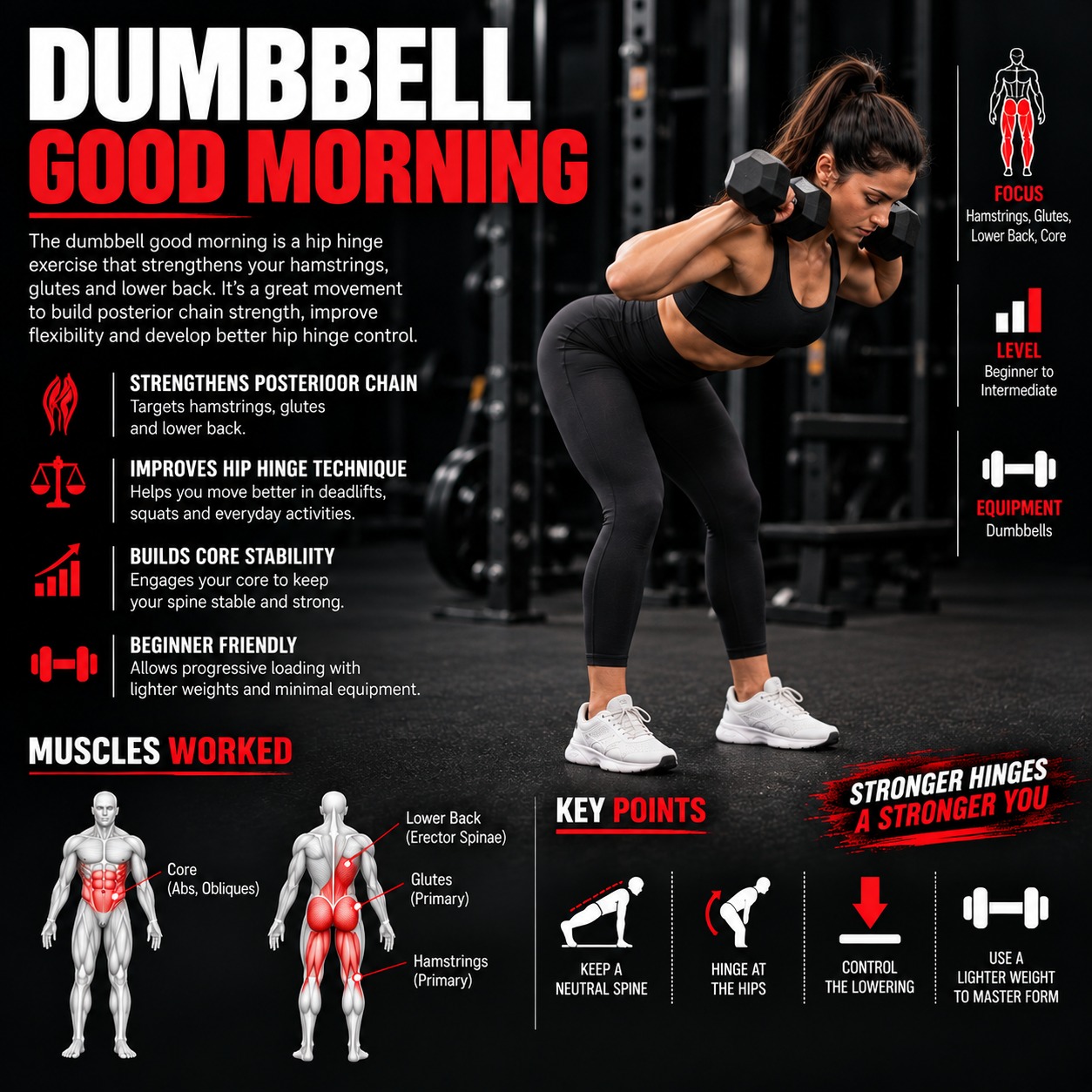
The dumbbell good morning is a hip-hinge exercise that works the hamstrings, glutes and lower back. It uses dumbbells instead of a barbell, allowing you to start with a lighter load and gradually build strength.
The exercise is performed by holding the dumbbells near your shoulders and hinging forwards from the hips. Because the movement relies heavily on good positioning and control, using a lighter weight is often more beneficial than trying to lift as heavily as possible.
Dumbbell good mornings can be included in lower-body workouts, posterior-chain sessions or full-body training programmes.
Master every exercise with expert coaching, personalised training plans, and a supportive gym environment designed to help you achieve real, lasting results.
| Detail | Information |
|---|---|
| Exercise Type | Compound |
| Main Muscles | Hamstrings, glutes |
| Secondary Muscles | Lower back, core |
| Equipment | Dumbbells |
| Difficulty | Beginner to Intermediate |
| Movement Pattern | Hip hinge |
| Best For | Posterior-chain strength |
The hamstrings are stretched and loaded during the downward phase of the movement.
The glutes help extend your hips and return your body to the standing position.
The erector spinae help maintain your torso position while you hinge forwards.
Your abdominal and trunk muscles help keep your body stable throughout the exercise.
Dumbbells allow you to start with a relatively light load while learning the hip-hinge technique.
The exercise targets several important muscles involved in lower-body movement.
It can help you become more comfortable with controlled hip-hinge movements.
Dumbbells are widely available and can be used without a squat rack.
Dumbbell good mornings can be used alongside exercises such as squats, lunges and Romanian deadlifts.
Choose two light dumbbells.
Hold one dumbbell over each shoulder.
Stand with your feet around hip-width apart.
Keep your knees slightly bent.
Brace your core and maintain a neutral spine.
Push your hips backwards while lowering your torso forwards.
Continue until you feel a comfortable stretch through your hamstrings.
Pause briefly while maintaining control.
Push your hips forwards and squeeze your glutes.
Return to a tall standing position.
Start lighter than you think you need.
Keep the dumbbells secure near your shoulders.
Push your hips backwards rather than simply bending forwards.
Maintain a neutral spine.
Keep your knees slightly unlocked.
Stop the movement when your hamstrings reach their comfortable range.
Use a slow and controlled tempo.
Using heavy dumbbells
Excessive loading can make it difficult to control your torso.
Rounding your back
Maintain a neutral spine throughout.
Turning it into a squat
The main movement should come from the hips.
Forcing extra depth
More range is not automatically better if you lose your position.
Moving too quickly
Controlled repetitions make it easier to maintain tension and technique.
Both exercises use the same basic hip-hinge pattern and target the posterior chain. The main difference is how the load is positioned.
A dumbbell version can be easier to load lightly and may be useful when learning the movement. A barbell variation can allow greater loading once you have developed sufficient technique and strength.
A dumbbell good morning is a hip-hinge exercise performed while holding dumbbells near your shoulders. It targets the hamstrings and glutes while also working the lower back and core.
Dumbbell good mornings primarily work the hamstrings and glutes. The erector spinae and core muscles also contribute by helping you maintain a stable torso throughout the movement.
Yes. Dumbbell good mornings can help develop posterior-chain strength and improve hip-hinge control. They can be included in lower-body, full-body or posterior-chain workouts.
Use a weight that allows you to perform each repetition with control and maintain a neutral spine. If you are new to the exercise, start with light dumbbells and increase the load gradually as your technique improves.
Neither variation is universally better. Dumbbell good mornings can make it easier to start with a lighter load and are convenient for home or gym workouts, while barbell good mornings can accommodate greater loading for experienced lifters.

 Blogs
Blogs